Table of contents:
The Problem With Traditional Logistics Training
Where Does VR Training Deliver Real Results in Logistics?
Why Do VR Pilots in Logistics Fail to Scale?
Enterprise vs. Mid-Market — Who Benefits Most


Logistics is one of the hardest industries to train people for. New hires need to learn equipment, standard operating procedures (SOPs), emergency procedures, and floor layouts — all at once, all fast. Turnover is high. Seasonal hiring surges compress timelines even further. And the margin for error on a warehouse floor is basically zero. Traditional training methods weren’t built for that reality.
At HQSoftware, we build custom Virtual Reality (VR) training solutions for industrial and logistics clients. We have seen firsthand what breaks in a conventional logistics workforce training program and what VR can realistically fix. This article, which is based on our experience, is an honest look at where immersive safety training delivers, where it stalls, and how to evaluate it before committing the budget.
If you are considering VR training for logistics — whether it’s in forklift safety, warehouse onboarding, or emergency procedures — this is the guide we wish existed when our first clients started asking the right questions.
The Problem With Traditional Logistics Training
Where Does VR Training Deliver Real Results in Logistics?
Why Do VR Pilots in Logistics Fail to Scale?
Enterprise vs. Mid-Market — Who Benefits Most
Traditional logistics training has a number of problems. In 2024, forklifts were involved in 84 work-related deaths and more than 25,000 serious injuries in the United States. OSHA estimates that 70% of those accidents could have been prevented with better training. Not better equipment. Not stricter rules. Better training.
A typical classroom or shadow-training program takes three to five days. It covers the theory. It ticks the compliance boxes. Then the new hire walks onto the floor and the real learning begins, often at the expense of mistakes.
Classroom instruction cannot replicate the stress of navigating a busy aisle with a loaded forklift. A trainer standing next to a new operator is not the same as making a high-stakes decision alone. You can watch someone parallel-park a thousand times and still freeze when it is your turn.
The problem compounds at scale. Training quality varies by trainer. Seasonal surges mean compressed timelines. And a distracted trainer on day three of their fifth onboarding that week is not delivering the same session they ran on day one.
Slow onboarding is not just a safety issue. It is a financial one.
New warehouse hires typically take six weeks to reach full productivity in standard picking and packing roles. More specialized positions involving equipment operation may require eight to twelve weeks. During that ramp-up period, error rates are higher, supervision is heavier, and output is lower.
Nearly 30% of new hires leave within their first 90 days, often due to poor onboarding experiences or unclear expectations. Every early exit means starting the cycle over — hiring, onboarding, waiting to reach full productivity. Companies that want to reduce warehouse injuries with VR and cut onboarding time are increasingly finding that traditional methods simply cannot scale to meet that demand.

According to PwC, VR employee onboarding produces employees who are trained up to four times faster than classroom learners, and 275% more confident in applying what they learned. That is not a marginal improvement. That is the difference between a new hire who is productive in week two and one who is still figuring things out in week six.

Want to see real VR and AR training projects from logistics and industrial clients?
Browse our case studies to explore how logistics and industrial companies implemented AR and VR training solutions, including the specific challenges they solved and the results they measured.
VR training delivers measurable results in four specific areas: forklift safety certification, new employee onboarding, emergency and hazmat procedures, and equipment maintenance. In each of these, the evidence is consistent enough to build a business case around.
OSHA requires documented forklift operator certification. That certification has to include a practical assessment component. Traditionally, that means putting a new operator on a real machine — with real risk.
VR changes that calculation. Operators practice tight-aisle maneuvering, load handling, pedestrian awareness, and tip-over scenarios in a simulated warehouse environment. Mistakes carry no real-world consequences. The same scenario can be repeated as many times as needed until the operator gets it right.
Companies using VR forklift simulation have reported a 30% reduction in incidents during the first six months of employment. That is the window when new operators are most vulnerable. Immersive safety training compresses the learning curve exactly where it matters most.

Warehouse VR onboarding cuts the time it takes to get a new hire productive, and real implementations back that up.
JD Logistics implemented VR training for warehouse sorting operations in 2024. Traditional onboarding took 15 to 20 days. With VR, that dropped to 1 to 2 days. Walmart compressed one training module from 8 hours to 15 minutes — a 96% reduction — while VR learners scored 70% higher on post-training assessments.
UPS and DHL are running VR employee onboarding programs at scale, too. UPS built its Integrad training centers in collaboration with MIT and Virginia Tech. DHL runs gamefied pallet-loading simulations across 40+ countries. The direction is consistent across both. Faster onboarding. More confident operators. Fewer errors on the floor.
This is where there is no real alternative to VR. You cannot run a realistic fire drill every week. You cannot simulate a hazmat spill without creating an actual hazmat situation. And you cannot ask a new hire to respond to an emergency they have never experienced and expect them to perform well under pressure.
An independent study conducted at Central Washington University found that 100% of participants reported that VR improved their comprehension of safety material, and knowledge retention at 30 days exceeded classroom-only groups. A separate randomized controlled trial published in NIH found that VR emergency training produced significantly higher long-term knowledge retention compared to video-based learning — 75.4% vs 69% after 30 days.
That is the same principle behind military and aviation simulation training. Applied to the warehouse floor, it means a new hire who has practiced a chemical spill response ten times in VR responds very differently from one who read about it in a manual.
For equipment maintenance, AR and VR often work together. VR trains the operator before they touch the machine. AR guides them through the repair when they do.
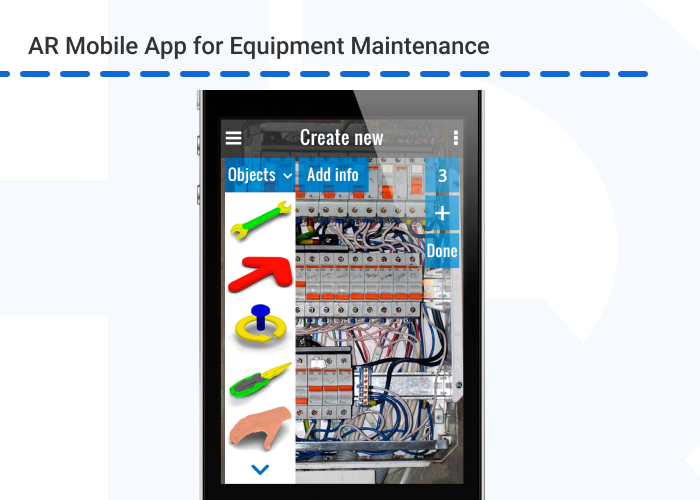
Beyond operator training, AR/VR development for enterprises is changing how maintenance teams diagnose and fix equipment. Workers receive step-by-step AR overlays directly on the equipment they are servicing — no manual, no waiting for an expert on site.
HQSoftware built exactly this kind of solution for a European provider of workforce mobility platforms for manufacturing and industrial companies. The result was a cross-platform AR mobile app that lets field technicians create and play back interactive repair guides enriched with 3D overlays — directly on the equipment, without training or expert support. The app is now in use across multiple industrial companies.
VR training for logistics pilots fail to scale for one reason: organizations treat VR as a hardware purchase, not a systems problem. The technology works. But the process design, IT infrastructure, and change management around it usually do not.
A pilot succeeds when conditions are controlled. A dedicated trainer runs the sessions. IT handles the headsets. The results look good on a slide.
Then the rollout begins. Headsets need to be tracked, charged, sanitized, and repaired across multiple sites. Content becomes outdated as procedures change. New trainers need to be onboarded into the system. And somewhere in the middle of all this, the original champion who drove the pilot moves to a different role. The bottleneck is rarely the technology. It is process design and IT infrastructure.
Here is what we tell clients who are planning to scale beyond a pilot. Treat the VR program like any other enterprise software deployment from day one. That means three things before you buy a single headset: a named IT owner responsible for hardware management, a content maintenance plan with a defined update cycle, and a change management process that does not depend on one internal champion to survive.
Companies that skip this planning stage do not fail at VR. They fail at scale. The technology is ready. The organization often is not.

Thinking about a first VR pilot or a full-scale rollout for your warehouse?
Tell us about your environment, your highest-risk training gaps, and your current systems. We will walk you through what a realistic solution looks like for your specific operation.
Dmitry Tihonovich
Business Development Manager
Standalone VR is an island. If training completion data does not feed into your learning management system (LMS), it does not exist from a compliance or HR perspective.
The baseline technical requirement for any enterprise VR employee onboarding program is SCORM or xAPI compliance. SCORM reports completion and scores to an LMS. xAPI goes further — it captures granular performance data that turns VR from a training tool into a logistics workforce training analytics platform.
Before signing any VR contract, ask two questions: Does the content export xAPI data? And does your LMS accept it? If the answer to either is no, you have an integration problem before you have a training program.
This is something we build into every project from the requirements stage. HQSoftware designs Virtual Reality training warehouse solutions with LMS and HR system integration as a standard requirement — not a feature you negotiate in at the end. The goal is not a standalone VR experience. It is a training program that fits into existing workflows, feeds into your reporting structure, and gives your L&D team data they can actually act on.
VR training ROI is not immediate, but it is predictable. The upfront investment covers hardware, content development, LMS integration, and change management. The savings come from three directions: fewer injuries, faster onboarding, and a lower trainer-to-trainee ratio.
The injury cost side is straightforward. Serious forklift incidents carry direct costs in medical treatment, lost productivity, and regulatory penalties — plus indirect costs that typically run two to five times higher. A program that prevents even a handful of incidents per year changes the economics significantly.
At HQSoftware, we build TCO and time-to-value estimates into every proposal before development begins. Not as a sales exercise, but because a client who understands the full cost picture makes better decisions about scope, phasing, and where to start.
VR training for logistics pays back fastest when training volume is high, locations are multiple, and consistency across sites is a business requirement. A 500-person distribution center and a 10,000-person 3PL network have fundamentally different constraints and different break-even points.
For enterprise logistics operators (10+ sites, high seasonal hiring, frequent onboarding surges) Virtual Reality solves a problem that classroom training structurally cannot. Standardizing immersive safety training across dozens of locations with different trainers, languages, and shift patterns is operationally expensive. VR makes the training identical every time, everywhere.
The Q4 logistics surge is the clearest example. Hundreds of seasonal hires need forklift certification and warehouse onboarding in a compressed window. A VR program that runs simultaneously across multiple sites, without requiring additional trainers, changes what is operationally possible during peak season.
For enterprises already running AI-powered operations and digital transformation programs, VR training integrates naturally into the broader L&D technology stack — especially when xAPI data feeds into workforce analytics platforms.

Mid-market logistics companies (one to three sites, 200 to 1,000 employees) can absolutely benefit from warehouse VR onboarding. But there is a hidden risk that catches many buyers off guard: content development costs.
Off-the-shelf VR modules exist. They are cheaper upfront. But generic content will not match your exact racking system, your equipment models, or your SOPs. A trainee who learns forklift operation in a simulated warehouse that looks nothing like their actual floor is not getting the full benefit of forklift safety training.
Custom development costs more. But generic training produces generic results, and in a safety-critical environment, that gap matters. This is where working with a development partner like HQSoftware, who builds to your specific layout and equipment, becomes the more practical choice.
The decision framework is straightforward. If your training scenarios are standard enough to match off-the-shelf content, start there. If your environment is specific enough that generic content would require workarounds, custom development will cost less in the long run than patching a program that does not quite fit.

Not sure whether off-the-shelf or custom VR training is the right call for your operation?
Talk to our team and walk through your site setup, training volumes, and existing systems. We will help you figure out what actually makes sense before you commit to anything.
Sofia Linden
Business Development Manager
Deploying Virtual Reality training warehouse programs successfully comes down to three decisions made before you buy a single headset: where to start, what to measure, and how to integrate.
Don’t start with everything. Pick one process where the cost of a mistake is high and the training volume is large. Forklift operation is the most common starting point — not because of compliance requirements, but because the risk is real, the training happens constantly, and the results are measurable within weeks. Every new hire needs it. Every site runs it. And if the training improves, the numbers show it fast.
The same logic applies to other high-risk processes: hazmat handling, loading dock procedures, emergency evacuation. The right first use case is the one where bad training has the most visible consequences — and where better training will be noticed immediately.
This is where most logistics workforce training programs go wrong. They measure what is easy: completion rates, satisfaction scores, time spent in headset. Those numbers look good in a report. They do not tell you whether the training worked.
The metrics that matter are operational:
SCORM and xAPI compliance are not optional. If your VR content cannot report data to your LMS, you are running a training program that exists outside your compliance records, your HR systems, and your workforce analytics.
The integration checklist is short but non-negotiable:
Get answers to these questions before you commission content development — not after.
VR works in logistics. The evidence is consistent across forklift safety, warehouse onboarding, and emergency procedures. The question was never whether the technology delivers — it is whether your organization is set up to use it properly.
If you are considering VR training for logistics — whether that’s a first pilot or a full-scale rollout — the starting point is a conversation about your specific environment, your existing systems, and where the highest-risk training gaps are.
That is exactly what HQSoftware does before any development begins. Talk to our team and walk through your options in 30 minutes.
AR/VR Expert
A developer with extensive expertise in AR/VR, very ingrained into the topic of Mixed Reality development. Shares his knowledge and the results of many years of work.


We are open to seeing your business needs and determining the best solution. Complete this form, and receive a free personalized proposal from your dedicated manager. Sergei Vardomatski Founder
Kick Off With Your Project Today