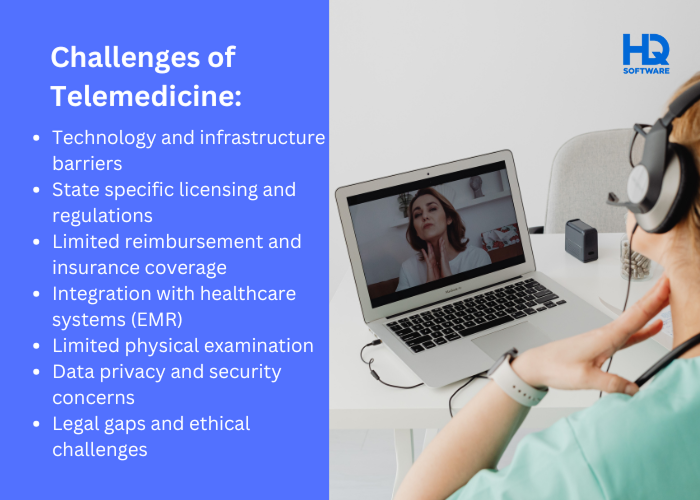
Data Privacy and Security Concerns
Medical information is particularly sensitive personal data. Medical history may include information about inherited diseases, mental disorders, addictions, infectious diseases, etc. It is unlikely that anyone would want this information to become public. However, when telemedicine services are used, this data is transmitted over communication networks and it becomes potentially vulnerable to hacking, leaks or unauthorised access. Understanding these threats is critical for both providers and patients who use telemedicine platforms.
The main security challenges in telemedicine include:
- Unsecured communication channels: Not all telemedicine platforms provide an adequate level of data encryption. The use of insecure communication channels can lead to the interception of sensitive information.
- Device vulnerabilities: Patients often use personal devices for telemedicine consultations that may not meet security standards or may be infected with malware.
- Cloud storage risks: Many telehealth services use cloud storage for medical data, which creates additional points of vulnerability, especially if the cloud provider does not adhere to strict security standards.
- Ransomware attacks: It is a type of malware that encrypts a victim’s files, demanding a ransom for the decryption key. These attacks can interrupt essential healthcare services, potentially jeopardising patient outcomes.
Potential solution:
There are a number of modern security technologies that can help protect patient data. Firstly, telehealth services should use end-to-end data encryption, multi-factor authentication, and intrusion detection systems. Secondly, regular security audits should be conducted. This includes independent security assessments of telemedicine platforms and data storage systems to identify and address vulnerabilities.
It is also very important to segment data. This means separating the most sensitive information and applying increased protection measures to it, restricting access to it to the minimum required number of persons.
But, let’s be honest, no security measure gives you 100% protection. That’s why it’s important to be prepared for data breaches. It is vital for providers of telehealth services to have a comprehensive data breach response plan in place. This includes immediate localisation of threats, timely notification of affected patients, and a detailed investigation to understand the scope and impact of the leak.
Legal Gaps and Ethical Challenges
Legislation in the field of healthcare has been shaped over decades. It is based on the traditional model of medical care – face-to-face interaction between doctor and patient. When telemedicine emerged, it began to bring fundamental changes to this process, creating situations that were not foreseen by existing legal norms. For example:
- When the doctor and patient are located in different regions or countries, there is a question as to which territory’s law should apply in case of disputes or litigation.
- When adverse consequences of a telemedicine consultation occur, it is not always clear who is responsible – the doctor, the telemedicine platform, the Internet provider or the equipment manufacturer.
- When Artificial Intelligence-based diagnostic tools are used in telemedicine, questions of liability arise. If an AI provides incorrect recommendations leading to a misdiagnosis, who is responsible—the physician who relied on it, the algorithm’s developers, or the medical institution that implemented the technology?
As for ethical challenges of telemedicine, one of the main ones is the issue of equality of access. Not all patients have the same opportunities to use telehealth services because of differences in technical literacy, access to the Internet or the necessary devices. This creates the risk of deepening existing inequalities in healthcare.
Another telemedicine issue is the quality of the doctor-patient relationship. Virtual communication can make it difficult to create a bond of trust that is often formed through face-to-face contact. It becomes more difficult for doctors to recognise non-verbal cues and the emotional state of the patient, which can affect the quality of diagnosis and treatment.
Potential solution:
Comprehensive solutions are needed to overcome these challenges. Firstly, specialised legislation needs to be developed. Namely, to create a legal framework that takes into account the specificities of telemedicine, including issues of jurisdiction, liability and quality standards. Secondly, telemedicine legislation should be harmonised between different regions and countries to eliminate legal conflicts in cross-border service delivery.
Need a custom software solution? We’re ready to help!
HQSoftware has a team of skilled professionals ready to tackle the project. Ask me!
Victoria Rokash
Business Development Manager
How to Overcome Common Challenges in Telehealth
As you learned from our article, despite the advancements in telemedicine services, certain barriers still affect the effectiveness of remote healthcare methods. These barriers can be grouped into three categories: technological, regulatory, and human factors. However, there are proven approaches to address each of these challenges.
| Challenges |
Recommendations for a solution |
| Technology barriers |
- Creating intuitive interfaces
- Providing technical support
- Development of offline modes for regions with unstable internet access
|
| Data privacy |
- Implementation of modern encryption methods
- Compliance with legislation on personal data protection
- Regular audit of security systems
|
| Limitations of the diagnosis |
- Development of home diagnostic devices
- Combining telemedicine with face-to-face visits
- Adoption of AI technologies to improve remote diagnostics
|
| Resistance from medical staff |
- Organisation of training programmes for doctors
- Financial motivation for mastering telemedicine technologies
- Demonstration of successful cases and improvement of clinical results
|
| State specific licensing and regulation |
- Developing interstate agreements for mutual recognition of medical licences
- Establishing a federal licensing system for telemedicine services
- Harmonisation of regulatory requirements across jurisdictions
|
Telemedicine Solutions With HQSoftware
HQSoftware specialises in healthcare solutions, offering comprehensive and flexible tools for telemedicine implementation. One of them is the development of chatbots and virtual assistants, which play an important role in improving the quality of remote medical care.
As an example, let’s look at the case of one of our customers. A US-based medical clinic faced challenges in managing a large number of patients and ensuring timely response to enquiries. The clinic approached the HQSoftware team with this problem. After a thorough analysis, we concluded that the clinic needed a scalable solution to optimize operations and improve patient care.
As a result of the collaboration, an Artificial Intelligence-powered chatbot was developed to integrate with the clinic’s existing systems to automate routine tasks such as organising appointments, patient reception and general enquiries.
If you would also like to develop a similar solution or something different for your healthcare facility, please contact us. We will be happy to help.
HQSoftware aims to be a reliable technology partner for medical organisations planning to implement or scale telemedicine services. Our team of experts is ready to develop a customized solution that not only meets modern telemedicine requirements, but also takes into account the prospects of digital healthcare development.