A doctor spends an average of 15 minutes per patient at each visit. One in four doctors manages to do this in less than 12 minutes. Now ask yourself: how many of those minutes are actually spent on medicine?
The rest goes to paperwork, repeated questions, scheduling gaps, and the administrative friction that no medical school prepares anyone for. The healthcare system doesn’t have a talent deficit. It has a time deficit!
Artificial Intelligence (AI) chatbots are one of the most practical answers to that problem. Not because the technology is new or impressive, but because it directly addresses where clinics lose time: routine requests, out-of-hours inquiries, appointment management, and the endless loop of the same patient questions answered by the same overworked staff.
But deploying a chatbot and deploying one that works are two very different things. At HQSoftware, we don’t offer off-the-shelf products — we build custom AI-driven solutions for healthcare organizations, shaped around their specific workflows, systems, and requirements. This guide reflects what we’ve learned along the way.
AI chatbots in healthcare are software systems capable of conducting meaningful dialogue with a user (via text or voice) to support clinical or administrative tasks. Unlike general-purpose assistants, medical chatbots operate within a defined context: they may be embedded in a clinic’s website, a hospital information system, a mobile app used by patients, or a messaging platform like WhatsApp or Telegram.
Their functions range from the straightforward (booking appointments, sending medication reminders, answering FAQs) to the more complex (triaging symptoms, supporting chronic disease management, or guiding patients through post-discharge care). Some AI chatbots follow rigid decision trees; others are powered by large language models capable of handling nuanced, open-ended conversations.
The more important question isn’t what they are — it’s which type is right for your use case.
Rule-Based vs. AI-Powered Healthcare Chatbots
Parameter
Rule-Based Chatbots
AI-Powered Chatbots
Technology
Decision trees, if/then logic
NLP, ML, LLMs (GPT-4, Med-PaLM)
Understanding
Keyword matching only
Context-aware natural language
Learning
Static — manual updates
Self-improving from interactions
Conversation Flow
Pre-defined, linear paths
Dynamic, multi-turn dialogues
Best for
FAQ, appointment booking
Symptom triage, clinical support
Development Cost
$15K–$50K
$50K–$300K+
Accuracy
High within scope, fails outside
Broad coverage, requires training data
Not sure where your use case falls on this spectrum?
You’re not alone — it’s one of the first questions every client asks us. See how we’ve solved it for healthcare organizations like yours.
How HQSoftware Built an AI-Powered Chatbot for a Medical Clinic
Theory is useful. A real example is better.
At HQSoftware, we developed an AI-powered chatbot for a medical clinic designed to automate patient communication and streamline administrative workflows. The solution was integrated directly into the clinic’s digital ecosystem, including its appointment scheduling system and internal infrastructure.
The chatbot handles a range of tasks, including:
answering frequently asked patient questions,
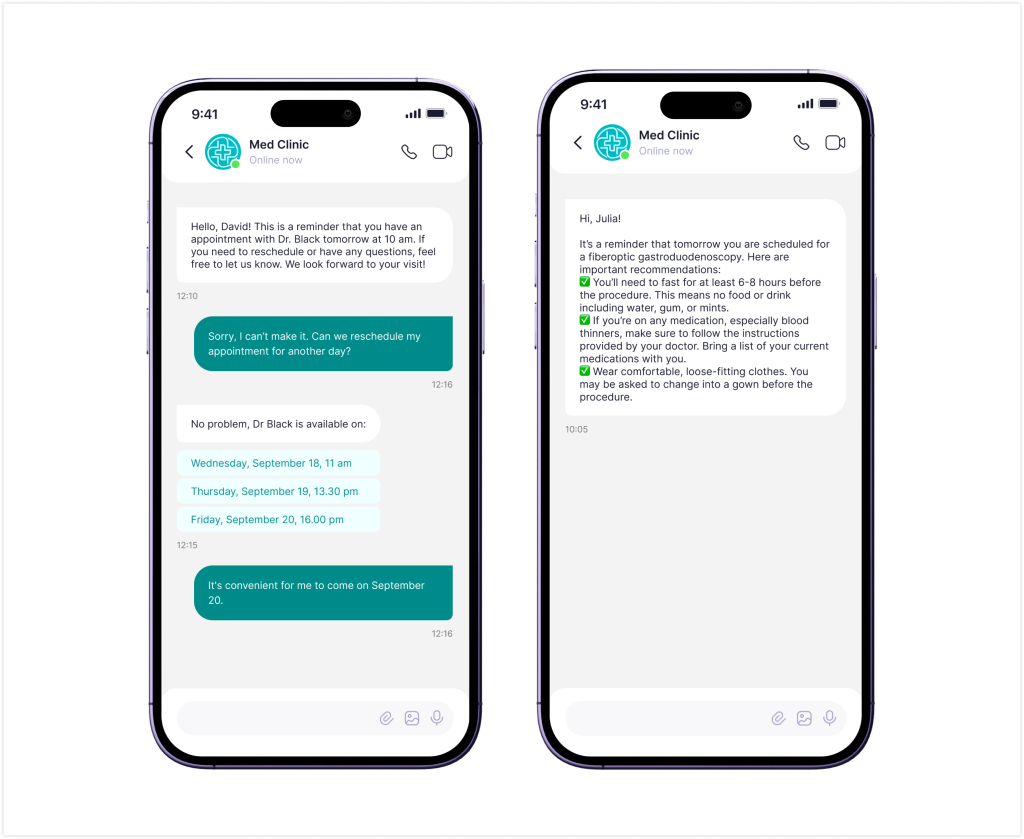
assisting with appointment booking and rescheduling,
guiding patients through initial symptom-related queries,
and reducing the workload on administrative staff.
One of the key challenges was ensuring that the chatbot could manage real patient interactions while maintaining clarity, accuracy, and compliance with healthcare data standards. This required careful design of conversation flows, as well as seamless integration with existing systems.
Appointment management
The results were measurable:
4x faster query resolution
35% reduction in call volume
30% boost in administrative efficiency
25% cut in operational costs
This project reflects a broader pattern: when designed and implemented correctly, AI chatbots in healthcare don’t replace human professionals. They eliminate operational bottlenecks, allowing medical staff to focus on providing more critical medical care.
Use Cases of AI Chatbots in Healthcare
AI chatbots in healthcare are not a one-size-fits-all tool with a single function. Depending on the context, they can serve as the first point of contact with a patient, an administrative assistant, a mental health support resource, or a 24/7 information service. Below are the scenarios where we see the strongest ROI and the fastest time to value.
Symptom Assessment and Triage
Not every health complaint requires calling an ambulance. But patients aren’t always able to assess the urgency of the issue on their own. AI chatbots can fill this gap: by asking structured questions about symptoms, they help determine the level of urgency even before the first contact with a doctor.
In addition to initial triage, chatbots can store data about each patient between sessions. That means shorter intake times and better-informed physicians before the consultation even begins.
Appointment Scheduling and Management
Making a doctor’s appointment shouldn’t require waiting on hold. AI chatbots allow patients to schedule, reschedule, or cancel appointments on their own at any time of day, without involving an administrator. More advanced solutions can match patients with the right specialist based on their symptoms, send patient information to the doctor in advance, and automatically create calendar entries for both parties.
The result is a more comfortable experience for patients and a significant reduction in missed appointments and administrative workload for clinics.
Health Information and FAQ Automation
A significant portion of calls to a clinic’s front desk boil down to the same questions: specialists’ office hours, what documents to bring, and how to prepare for a procedure. For staff, this is a time-consuming routine.
AI chatbots can automatically handle this volume of communication, freeing up clinical staff for tasks that require human interaction and ensuring that patients receive accurate and consistent information at any time. For a mid-size clinic, this alone can save dozens of staff hours per week.
Chronic Disease Management
Chronic conditions (such as diabetes, hypertension, and asthma) require ongoing management rather than occasional attention. This is precisely where AI chatbots demonstrate one of their most tangible benefits: they can remind patients daily to take their medication, record their health metrics, and track deviations from normal levels without placing an additional burden on medical staff.
Patient Onboarding and Insurance Verification
A patient’s first visit to a clinic often begins with paperwork: forms, consent forms, and insurance verification. This process is equally tedious for patients and time-consuming for staff. AI chatbots allow this process to be handled outside the reception area: patients complete the onboarding process in advance, at their own pace, using a familiar interface.
Automated insurance verification reduces administrative errors and speeds up the registration process. This is especially important for medical facilities with high patient volume.
What Are Key Benefits of AI Chatbots for Healthcare Organizations?
AI chatbots offer numerous advantages, but these can be divided into three categories depending on the beneficiaries: patients, healthcare staff, or the organization as a whole.
The case for AI chatbots in healthcare comes down to three groups of people — and what changes for each of them.”
For Patients: 24/7 Access and Reduced Wait Times
The main benefit for patients is immediate access. The chatbot responds instantly, at any time of day, without a wait and without the need to explain the context anew with every inquiry. For people with chronic conditions, anxiety, or limited mobility, this isn’t just a convenience, it’s a real reduction in the barriers to getting help.
For Providers: Lower Administrative Burden and Burnout
Doctors and nurses spend a significant portion of their workday on tasks that do not require clinical expertise: answering routine questions, filling out paperwork, and sending reminders to patients. AI chatbots take on this workload, freeing up staff time for the work they were trained to do. Reducing routine tasks is also directly linked to a decrease in burnout — one of the most pressing issues in modern healthcare.
For Organizations: Cost Savings and Operational Efficiency
One of the most tangible benefits of implementing AI chatbots in healthcare is the reduction in operational costs. Automating administrative tasks such as processing incoming inquiries, scheduling appointments, verifying insurance, and sending reminders reduces the workload on staff without compromising service quality. In practice, this can mean a 25% reduction in operational costs and a 30% boost in administrative efficiency — as one of our clinic clients experienced after implementation.
Operational efficiency is equally important. A chatbot scales instantly: during peak periods (epidemics, high-volume inquiries), it handles thousands of requests simultaneously and avoids the need to hire additional staff. At the same time, every interaction generates structured data that allows you to analyze bottlenecks, forecast demand, and make more informed management decisions.
Still dealing with rising operational costs and overwhelming call volume?
We help healthcare organizations automate routine patient interactions and reduce administrative burden. One clinic cut operational costs by 25% and call volume by 35% after implementation. Want to see what’s realistic for your organization?
Ensures conversation continuity and smooth handoff of complex cases to a human specialist
What Are Real-World Examples of AI Chatbots in Healthcare?
Deploying AI chatbots in healthcare is no longer experimental; they are now fully operational tools. The number of such chatbots in use is growing alongside technological advancements, and they are being applied to an increasingly wide range of medical tasks. Below are some of the most notable examples from various areas of healthcare.
Symptom Triage: Ada Health, Infermedica, Buoy Health
Ada Health guides users through a structured symptom assessment and generates a personalised report that can be shared with a physician. With over 35 million assessments completed, it is one of the most widely used AI triage tools globally.
Infermedica powers symptom checkers and triage flows for hospitals and insurers across more than 30 countries. Its API-based model allows healthcare organizations to embed clinical decision support directly into their own platforms.
Buoy Health was developed in collaboration with Harvard Medical School. It analyzes symptoms in real time and directs users to the most appropriate level of care, from self-treatment to emergency services, reducing unnecessary ER visits.
Mental Health: Wysa, Youper
Wysa is an emotionally intelligent chatbot that uses CBT-based techniques to help users manage stress, anxiety, and low mood. It operates as a between-session support tool and is used by employers, insurers, and healthcare providers in over 65 countries.
Youper combines AI-driven conversation with mood tracking and personalized mental health insights. It has been studied in peer-reviewed research and shown to reduce symptoms of anxiety and depression in short-term use.
Public Health: WHO Health Alert, CDC COVID-19 Self-Checker
WHO Health Alert was launched on WhatsApp during the COVID-19 pandemic to deliver verified information directly to the public at scale. It reached over 120 million people across 180 countries within months of launch.
CDC COVID-19 Self-Checker allowed users to assess their symptoms and receive guidance on whether to seek medical care, self-isolate, or monitor at home. At peak usage, it handled millions of interactions per week, demonstrating the capacity of chatbots to support public health infrastructure during crisis periods.
These tools prove the market is mature and the technology works. But Ada Health is built for consumers, Infermedica for insurers, Wysa for mental health — none of them are built for your clinic’s workflows, your EHR system, or your patient communication patterns. That’s the difference between an off-the-shelf product and a custom solution.
Tired of chatbots that don’t fit your workflows, EHR, or patient volume?
We build tailored AI solutions designed around how your clinic actually operates — from patient communication to operational workflows. The result is a system that fits your team, your processes, and your patients.
Build Your Custom Healthcare Chatbot With HQSoftware
AI software development for healthcare is not a generic task. Most vendors sell you a platform. We build you a solution — one that fits your workflows, your systems, and your compliance requirements from day one. You can explore our work firsthand in our project portfolio.
Every chatbot we build is HIPAA-compliant by design, integrated with EHR/EMR systems and shaped around the specific workflows of your organization.
Step 1 — Define Goals and Use Cases
At HQSoftware, we begin each project by mapping real clinical and operational workflows to specific use cases. This ensures the solution is not just technically feasible, but genuinely valuable in practice. Our experience shows that precise scoping at this stage significantly reduces risks later and lays the groundwork for a solution that delivers measurable results.
Step 2 — Choose the Right Technology Stack
We choose and architect technology stacks based on each client’s specific needs, balancing advanced NLP capabilities with strict compliance requirements such as HIPAA and GDPR. We also ensure seamless integration with existing systems, including EHR/EMR platforms and patient portals.
This tailored approach allows us to build scalable, secure, and future-proof solutions rather than one-size-fits-all products.
Step 3 — Design Conversation Flows and Medical Knowledge Base
Our team at HQSoftware combines UX design expertise with domain knowledge to create clear, safe, and intuitive dialogue flows. We develop structured medical knowledge bases that are aligned with clinical guidelines and validated data sources.
We also pay special attention to high-risk and sensitive scenarios, ensuring the chatbot knows when to guide, when to clarify, and when to escalate to a human professional.
Step 4 — Develop, Train, and Test
At HQSoftware, development is a full-cycle process that goes far beyond implementation. We build robust backend architectures, integrate AI models, and connect the chatbot with healthcare systems while maintaining strict security standards. Training is performed using domain-specific data and is continuously refined to improve accuracy and relevance.
Testing is equally critical. We conduct comprehensive QA, including real-world and edge cases, to ensure the AI chatbot performs reliably in practice, not just in controlled environments.
Step 5 — Deploy, Monitor, and Iterate
After deployment, HQSoftware provides ongoing monitoring and optimization based on real user interactions and performance metrics. We track key indicators such as response accuracy, escalation rates, and user satisfaction to identify improvement opportunities.
Our clients benefit from continuous iteration and support, ensuring their chatbot adapts to changing user needs, regulatory requirements, and business goals.
What Are the Challenges and Limitations of Healthcare Chatbots?
“What if the chatbot makes a clinical mistake?”
A chatbot is a tool, not a clinician. Even advanced models can misinterpret symptoms or miss context. That is precisely why all interaction scenarios must be designed and reviewed by medical professionals, and the system must correctly recognize when to escalate to a live doctor.
At HQSoftware, every clinical conversation flow is developed in collaboration with healthcare domain experts and includes clearly defined escalation thresholds. The chatbot is never the final decision-maker in clinical scenarios.
“We can’t afford downtime in a healthcare environment.”
The healthcare environment cannot tolerate downtime. A chatbot failure—whether it’s service unavailability, an incorrect response due to a technical error, or the loss of session data—can directly affect the patient. System reliability requires a well-designed infrastructure: redundancy, real-time monitoring, and clear protocols in case of failure. A chatbot that “sometimes doesn’t work” is unacceptable in healthcare.
Our solutions are architected for high availability from day one, with monitoring and incident response processes built into the delivery scope.
“How do we protect sensitive patient data?”
Health information is one of the most sensitive categories of personal data, and AI chatbots, by their very nature, handle it directly. A data breach or unauthorized access to patient data results not only in reputational damage but also in serious legal consequences. Compliance with HIPAA, GDPR, and local regulations must be built into the solution’s architecture from day one of development, rather than added after the fact.
Every solution we deliver at HQSoftware is HIPAA-compliant by design, with end-to-end security audits conducted before deployment.
“The regulatory landscape is unclear.”
Healthcare is one of the most heavily regulated industries, and AI chatbots are no exception. Depending on the product’s functionality, it may be subject to FDA (U.S.) requirements, CE marking (EU), or local regulatory requirements, which significantly increases the time and cost of bringing the product to market.
At the same time, the regulatory framework is still evolving: requirements are changing, and there are currently no uniform international standards for medical AI systems. For development teams, this means they must incorporate a compliance strategy from the very start of the project.
Final Thought
The potential of AI chatbots in healthcare is real. So are the risks. Getting it right requires more than good technology: it takes healthcare domain knowledge, regulatory awareness, and engineering discipline.
At HQSoftware, we bring all three. We have delivered for healthcare organizations at every stage, from early research to full deployment. Whether you’re at the research stage or ready to build, we’d love to hear about your project. Get in touch.
An experienced software developer specializing in IoT and AI-driven technologies. Having contributed to more than 20 IoT projects, shares practical expertise and insights on connected software development, AI integration, and intelligent solutions.
How Much Does It Cost to Develop a Healthcare Chatbot?
Costs vary significantly depending on complexity. Rule-based chatbots typically range from $15K to $50K, while custom AI-powered solutions can run from $80K to $300K or more. Key cost drivers include the level of EHR integration, regulatory requirements, and the sophistication of the NLP/LLM layer.
Can Healthcare Chatbots Replace Doctors?
No and they’re not designed to. AI chatbots in healthcare handle triage, administrative tasks, and first-line patient support effectively. But any clinical decision (diagnosis, treatment, prescription) requires a qualified human. A well-designed chatbot knows its limits and escalates to a specialist when needed.
What Technologies Power Healthcare Chatbots?
Most modern healthcare chatbots combine NLP and ML for language understanding, large language models such as GPT-4 or Med-Gemini for dialogue, and FHIR APIs for EHR integration. Cloud infrastructure (AWS or Azure) provides the scalability and security that healthcare environments require.
How Long Does It Take to Build a Healthcare Chatbot?
A custom AI solution typically takes between four and nine months from discovery to deployment. An MVP can be delivered in three to four months, depending on scope. The main variables are the number of integrations, regulatory requirements, and the complexity of the conversational flows involved.
How Do Healthcare Chatbots Ensure HIPAA Compliance?
HIPAA compliance must be built in from day one, not added as an afterthought. This means end-to-end encryption, strict access controls, audit logs, and PHI de-identification. Vendors must also sign a Business Associate Agreement (BAA). A chatbot that handles patient data without these safeguards in place is a liability, not an asset.
We are open to seeing your business needs and determining the best solution. Complete this form, and receive a free personalized proposal from your dedicated manager.
Sergei Vardomatski
Founder
We use cookies to analyze traffic, personalize site content, and for social media features. We share this
data with our ad and social media partners. You can change your cookie settings and learn more
here. By browsing the website you consent to our rules.