

Highlights
Need
To simplify collaboration around industrial prototypes by making complex engineering models accessible to non-technical stakeholders and accelerating review and approval workflows
Solution
A semi-automated Unity-based tool that transforms complex CAD files into optimized interactive 3D models
Up to 30%
reduction in review cycles
Days → Hours
сross-dept feedback time
Outcome
HQSoftware delivered a Proof of Concept (PoC) for a semi-automated 3D visualization and collaboration tool built around industrial CAD workflows. The solution helped convert CAD models exported from SolidWorks into interactive 3D assets that could be visualized in real time, reviewed by stakeholders, and smoothly moved through the approval workflow.
The PoC demonstrated the ability to:
- accelerate prototype review and approval processes
- simplify interaction with complex industrial models
- reduce dependency on engineering-only CAD environments
- improve collaboration between technical and non-technical teams
- create reusable 3D assets for presentations and internal product discussions
Despite the complexity of CAD processing workflows, the HQSoftware team was able to rapidly validate the concept and deliver a working PoC within a short R&D cycle.
Customer
Our client is an enterprise-level oil and gas company specializing in the design, prototyping, and licensing of industrial drilling and extraction equipment.
Their product development workflow involved multiple departments, including engineering, industrial design, stakeholders, sales, and training teams. However, the company relied heavily on SolidWorks and other CAD tools that produced highly technical outputs difficult for non-engineering users to interpret.
As a result, prototype reviews, stakeholder approvals, and cross-department collaboration became time-consuming and inefficient. The client needed a way to transform complex engineering assets into accessible interactive 3D experiences that could support collaboration, presentations and feedback collection.


Solution
The project began with an extensive R&D phase during which our team evaluated more than 20 CAD processing frameworks, plugins, and optimization tools to identify the most scalable and cost-efficient technology stack for the PoC. Based on the research results, Unity Industry was selected as the core platform, thanks to its native CAD integration capabilities, optimization tools, scalability, and lower long-term maintenance costs.
Building on Unity Industry and its CAD converters, the HQSoftware team developed three custom components that form the backbone of the processing pipeline.
- SolidWorks integration connector
A custom integration that pulls CAD models directly from SolidWorks into Unity with a single action. The connector handles geometry processing and asset compression automatically, producing a base model ready for the next stages without any manual file handling.
- Automatic material assignment script
SolidWorks files contain metadata tags that specify the material of each component (copper, rubber, steel, wood, and so on). The team developed a tag interpretation script that automatically applies the correct visual material from a purpose-built asset library to each part. The operator then reviews and confirms the result with a single action before moving forward.
- Assembly structure parser
As part of the export process, the system reads the CAD assembly metadata and generates a structured list of all removable and interactive components (bolts, levers, hatches, gears, springs, and so on). This hierarchy is what enables the interactive disassembly functionality in the viewer, which allows users to take apart and inspect individual components in real time.
At the same time, the workflow remains semi-automated. CAD export, geometry optimization, material assignment, and assembly parsing all run automatically. Final validation — verifying that the geometry imported correctly, materials are accurate, and the part hierarchy is complete — is performed by a specialist before the model is published. This keeps quality consistent without slowing the pipeline down.
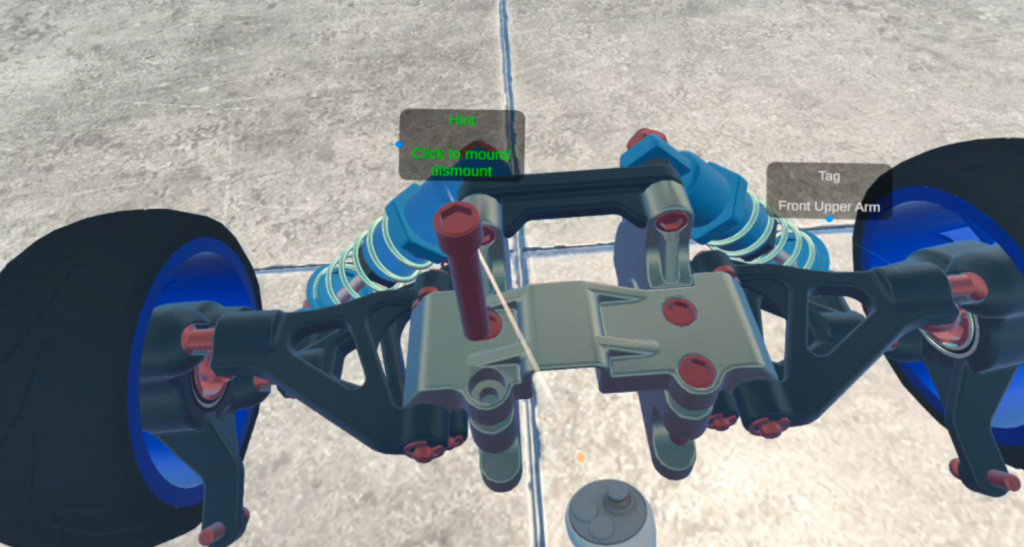
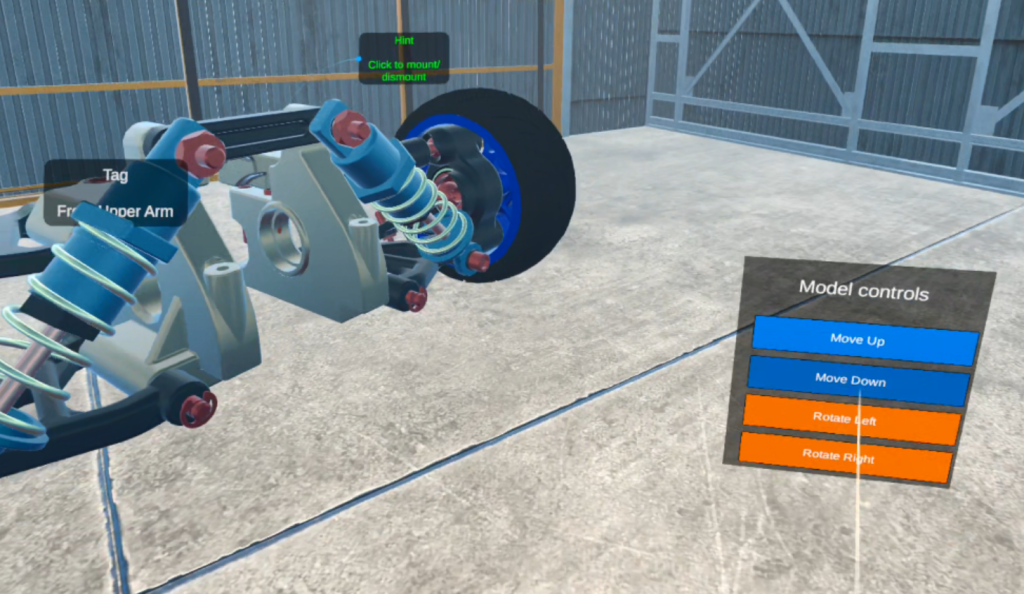
The PoC also included a basic interactive review environment where users could:
- rotate and inspect 3D models
- zoom in to individual components
- interact with detachable assemblies
- leave comments and approval feedback
Challenges
One of the main challenges was the absence of reliable, fully automated CAD-to-3D conversion workflows. Existing solutions could not provide consistent one-click transformation of engineering assets into production-ready real-time 3D models. This made a semi-automated approach the only viable path and shaped the entire architecture of the pipeline.
Another important challenge involved protection of intellectual property. Since the client worked with highly sensitive engineering data, the solution architecture was designed as a secure, isolated ecosystem, with controlled access and private infrastructure principles.
The team also had limited access to original proprietary assets during development. To continue the PoC securely, publicly available mock 3D models and engineering assets were used for testing and validation.
Looking for similar solutions or something unique to your needs?Contact us today! We’re happy to explore your needs!
Victoria Rokash
Business Development Manager

Future Plans
The PoC established a strong foundation for further development into a full-scale industrial collaboration and visualization platform.
A natural next step for the solution is expanding the solution into a multi-user review environment, where engineers, designers, and stakeholders could collaborate on the same 3D model in real time. Planned functionality includes persistent comments, approval workflows, version history, and voice communication tools for distributed teams.
Other potential areas for development include integration with corporate training programs, where the same 3D models could be reused for Virtual Reality safety simulations, interactive onboarding, and training in equipment operation. This approach would allow companies to turn engineering assets into practical learning tools without creating separate training content from scratch.
The solution was also designed with scalability in mind, for use in sales and marketing. Future iterations could support centralized 3D product catalogs for exhibitions, presentations, and customer demonstrations, allowing business teams to showcase industrial equipment in an interactive format without requiring engineering software knowledge.
Team
- Project manager
- Unity developer
- 3D Artist/Visual Effects Specialist
Learn more about our custom software development services.

We are open to seeing your business needs and determining the best solution. Complete this form, and receive a free personalized proposal from your dedicated manager. Sergei Vardomatski Founder