Table of contents:
Telemedicine Apps – Market Overview
Benefits of Telemedicine Apps for Doctors and Patients
Top 10 Essential Telemedicine Software Features
Advanced Features for a Telehealth App


Looking for smarter ways to deliver quality care while overcoming packed workloads and geographical barriers? Thankfully, telemedicine applications offer a powerful solution. By leveraging telemedicine software, you can extend your reach, streamline workflows, and enhance patient satisfaction. But what exactly makes a telemedicine app successful?
In this blog post, we’ll explore the essential features that define effective telehealth solutions and share practical insights from our experience in telemedicine app application development.
Telemedicine Apps – Market Overview
Benefits of Telemedicine Apps for Doctors and Patients
Top 10 Essential Telemedicine Software Features
Advanced Features for a Telehealth App
The global telemedicine app market is projected to hit $185.66 billion by 2026 from $38.3 billion in 2020. That’s a nearly 5x growth in just six years. But what’s driving this? The answers are many: a mix of tech advancements, post-pandemic demand, and a global push for accessible care.
Telemedicine apps are tools that let patients connect with doctors remotely, right from a phone or computer. Instead of going to a clinic, patients can set up video calls, message a doctor, or even get tips for dealing with symptoms through these apps.
Statistics reveal that 76% of patients are eager to use telemedicine. That’s 7 out of 10 people opting for virtual visits over waiting rooms. Why? Convenience, speed, and the comfort of connecting with doctors from their couch. Patients with chronic conditions, busy parents, and rural communities are leading this charge.
As for healthcare providers, it could save, for instance, the U.S. healthcare system $100 billion annually by optimizing resources. So, the benefits for both healthcare providers and patients are evident.

To be more informed, let’s look at the current market trends:
Overall, in healthcare systems that are criticized for inefficiency and high costs, telemedicine is a highly effective option that can simultaneously improve convenience and reduce expenses.
Before moving on, watch a quick video on how we develop a custom healthcare application.
Designed for both doctors and patients, telemedicine apps provide a range of unique benefits to each. To understand their full potential, let’s consider some of the more specific advantages these readily available tools offer.
For doctors:
For patients:

Now that we’ve considered the impact of telemedicine on healthcare accessibility, let’s look at the features an app needs to be efficient.
Considering custom software?HQSoftware’s team of experts can design and develop the perfect solution for your business. Let’s discuss it
Dmitry Tihonovich
Business Development Manager
For a telemedicine application to be effective, certain features are crucial. This applies to both custom and pre-built solutions. We’ll explore these features in more detail below.

As a healthcare provider, you understand the importance of connecting patients with the right specialist quickly and efficiently. A robust search and filter feature in your telemedicine software will allow your patients to find doctors based on their specialty, unique expertise, language, location, or availability.
For you, this means a steady flow of relevant patient referrals, reduced administrative burden, and the ability to focus on delivering high-quality care to those who need your expertise most.
Replace cumbersome email scheduling with direct in-app booking. This feature synchronizes with doctors’ calendars, displaying available slots and providing options for instant and scheduled consultations. Patients can book and view upcoming appointments and receive automated reminders.
You’ll be able to reduce time spent on administrative tasks, face fewer scheduling conflicts, and have more time dedicated to patient care. Plus, with features such as waitlist management and cancellation notifications, you can ensure that your practice runs smoothly even during peak times.
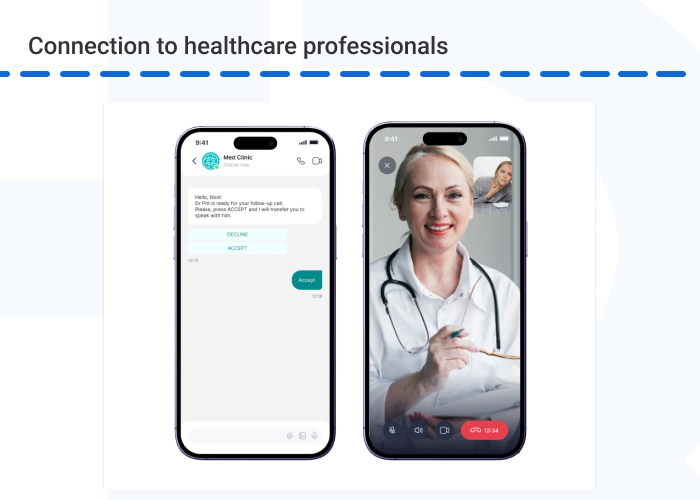
High-definition (HD) video conferencing can become your virtual exam room, where doctors in many cases can conduct consultations with the same level of precision and care as at an in-person visit. With crystal-clear audio and video, they can observe visual cues, assess symptoms, and build rapport with patients from a distance. This is the core function of any telemedicine software.
Video calls eliminate the need for unnecessary in-person visits, expand your reach to patients in remote areas, and enhance your ability to provide timely diagnoses.
In cases where follow-up questions do not require a video consultation, secure, HIPAA-compliant messaging can become an effective tool to streamline communication between physician and patient. A HIPAA-compliant secure text messaging and chat feature enables it to respond to patient inquiries, clarify treatment plans, or provide follow-up advice without the need for a full consultation.
By keeping sensitive information protected, this feature ensures you can focus on delivering care with confidence, knowing your practice remains compliant and secure.
Documenting patient visits accurately is a critical part of any healthcare provider’s workflow, and visit notes templates are here to simplify the process. These pre-designed, customizable templates allow doctors to quickly record symptoms, diagnoses, treatment plans, and follow-up instructions.
This means consistency and compliance with regulatory standards, less time spent on paperwork, and reduced risk of errors associated with human work. Additionally, organized records make it easier to collaborate with other providers or prepare for future visits.
Need a custom software solution? We’re ready to help!HQSoftware has a team of skilled professionals ready to tackle the project. Ask me!
Victoria Rokash
Business Development Manager
Enhance patient convenience with an integrated in-app pharmacy. These tasks can be completed with just a few clicks, benefiting both doctors and patients.
With this tool, you can electronically send accurate prescriptions directly to pharmacies, check for potential drug interactions, and track patient adherence. Through the app post-consultation patients can choose between home delivery or pickup at a local pharmacy.
Your patients’ medical histories are the foundation of your informed decision-making, and EHR integration ensures you have all the data you need at one place. This means you’ll seamlessly connect your telemedicine software to your existing EHR to get instant access to lab results, past diagnoses, allergies, and more.
As a result you’ll spend less time chasing down records, provide fewer redundant tests, and improve overall care coordination.
Following an exchange of data, you must prioritize ongoing secure storage and management of this information. With this feature you’ll be able to safely upload medical images, test results or videos and share them with colleagues for review at their convenience.
Store and forward data exchange facilitates gathering expert opinions and ensures that your patients receive the best possible care, regardless of geographical barriers.
Provide a simple payment system. Patients should be able to pay for consultations easily with credit cards, PayPal, or other payment methods. For broader coverage, integrate with health insurance plans.
This feature allows you to generate transparent invoices, process payments securely, and handle insurance claims directly within the telemedicine platform. The app should also handle direct billing, co-pays, and automatic claim submissions. A frictionless process is key to preventing abandoned bookings.
For patients with chronic illnesses or ongoing treatments, remote patient monitoring (RPM) through wearables and IoT devices is truly one of the best tools. Continuous monitoring of vital signs such as blood pressure, glucose, and heart rate provides doctors with real-time data and enables proactive care.
Perhaps it would be useful to incorporate emergency services within the app, so patients can seamlessly contact the necessary medical centre.
Overall, for you as a healthcare provider, these benefits lead to early issue detection, the ability to adjust treatments quickly, and fewer hospital readmissions.
As a company specializing in advanced technologies, we’ve developed numerous healthcare solutions and discovered that integrating some other advanced features is essential for creating a robust telehealth app.
Drawing from our extensive experience, the following features will make your solution more competitive on the market:
Advanced AI chatbots can do more than answer simple FAQs. They can triage symptoms by asking targeted questions, manage medication adherence over time, and nudge to book a follow-up if symptoms worsen. Based on the analyzed information, bots can direct patients to the right level of care. This might be self-care resources, a scheduled appointment, or urgent care.
For chronic conditions such as diabetes, a chatbot could analyze glucose logs and suggest lifestyle tweaks. However, such a chatbot needs to feel friendly and understanding, not like a machine. And it should always be easy to connect with a real doctor if a patient needs to.
At HQSoftware, we’ve built an AI-powered chatbot that seamlessly integrates with the clinic’s current systems to automate routine tasks, including appointment management, new patient onboarding, and handling general inquiries. The core features are:
Augmented and Virtual Reality technologies enhance, rather than replace, human work. Immersive technologies provide interactive experiences that improve understanding and reduce anxiety about medical procedures and diagnoses.
For example, a dermatologist could use Augmented Reality to virtually “mark” a concerning mole on your skin through your phone’s camera. This will allow for better remote assessment and tracking changes over time.
Computer vision uses AI to “see” and interpret images. In telehealth, AI can analyze a video of a patient walking to assess their gait and identify potential mobility issues, or analyze a close-up image of a skin rash to help a dermatologist pre-diagnose conditions.
With computer vision, a telehealth app could analyze skin lesions for signs of melanoma, or even detect subtle facial cues like pallor or jaundice to flag potential issues. For physical therapy, it could give real-time feedback on your posture during exercises.
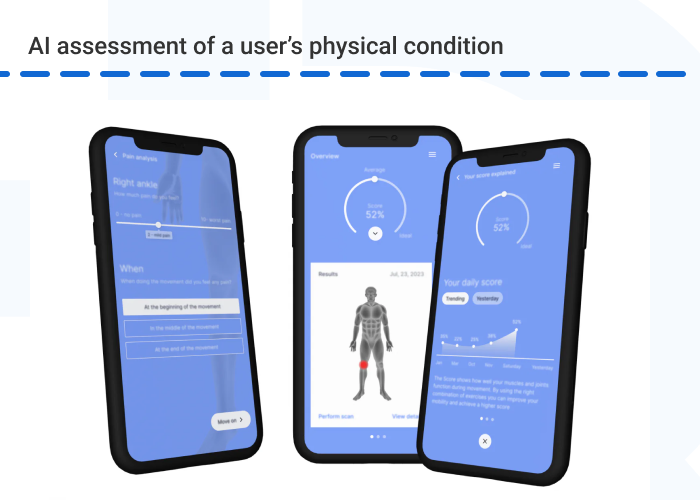
AI mobile app for diagnostics assesses functional disorders by scanning body movements and using AI to analyze mobility. It evaluates movement patterns through a standardized functional movement test. If your body movement test results are concerning, you can request professional advice. Through the app, you can consult with a doctor and receive expert recommendations.
AI-powered clinical decision support apps (CDS) provide doctors with a review of a patient’s history where AI automatically flags potential drug interactions, suggests relevant diagnostic tests based on symptoms, and provides evidence-based treatment guidelines for a specific condition.
These systems can analyze vast amounts of medical literature and patient data to identify patterns and insights that a human might miss. Implementing CDS in your telemedicine solution can help reduce medical errors and ensure that every patient receives the most appropriate treatment.
Curious how to develop a really successful solution? We know how to do it.
Here at HQSoftware, we’re passionate about helping healthcare providers like you. We understand that modern healthcare demands seamless, secure, and patient-centric solutions.
Take a peek at some of the key services we offer:
Moreover, our relationship doesn’t end at launch. We provide ongoing support and maintenance to keep your telemedicine app running smoothly and adapt to evolving needs.
Let’s get into some of the hurdles you might encounter when building your telemedicine app. Because knowing them upfront is half the battle, right?
Here are three big challenges and how we can tackle them together:
You’re handling incredibly sensitive data, and patients need to trust that their information is safe with you. So, ensuring compliance with regulations such as HIPAA and GDPR is non-negotiable. A single breach can erode trust and lead to legal repercussions.
Our solution: We embed security into every layer of development by using end-to-end encryption, rigorous access controls, and regular audits. Our team stays ahead of evolving regulations, ensuring your app meets global standards while safeguarding patient privacy.
Telemedicine apps rarely exist in isolation. Hospitals and clinics use electronic health records or electronic medical records, and your app ideally needs to connect with these systems to avoid data silos and double work. Some healthcare organizations rely on outdated EHRs or disconnected tools, creating interoperability nightmares that slow down care delivery.
Our solution: We’ll plan for integration right from the start. We have experience working with healthcare APIs and standards like FHIR, and we can build your app to be interoperable. This means your app will be able to communicate effectively with other systems, creating a smoother and more efficient workflow for everyone involved.
Telemedicine apps must work flawlessly across devices such as iOS, Android and web and adapt to varying screen sizes, operating systems, and hardware capabilities. Inconsistent performance like laggy video calls on older smartphones or browser crashes can frustrate users and harm your app’s reputation.
Our solution: We employ a hybrid development approach, combining native optimization for critical features, for instance video streaming, with cross-platform frameworks to ensure broad accessibility. Rigorous testing across devices, network conditions, and operational system versions helps us clear out bottlenecks. We prioritize lightweight design and caching strategies to maintain speed and reliability, even on low-bandwidth connections.
By addressing this challenge, your app will deliver a seamless experience to every user. Ready to explore how HQSoftware can help you create a telemedicine app? Let’s connect!

Head of Production
To ensure the outstanding quality of HQSoftware’s solutions and services, I took the position of Head of Production and manager of the Quality Assurance department. Turn to me with any questions regarding our tech expertise.


Subscribe for more!
We are open to seeing your business needs and determining the best solution. Complete this form, and receive a free personalized proposal from your dedicated manager. Sergei Vardomatski Founder
Kick Off With Your Project Today