Table of contents:
The State of AI in Software Development
Where AI Saves Development Time
When AI Doesn’t Speed Things Up
How to Maximize AI’s Time-Saving Potential


Your competitor just shipped a major feature update. Again. Meanwhile, your development cycle is stuck in the same rhythm: long planning sessions, delayed sprints, mounting technical debt, and a product roadmap that keeps getting pushed back.
If this sounds familiar, you’re not alone. A Boston Consulting Group analysis found that nearly half of executives report more than 30% of their software projects experience delays or cost overruns. The problem isn’t your team. It’s the way software has traditionally been built. And the gap between companies that have adapted and those that haven’t is growing every quarter.
At HQSoftware, we’ve been building custom software for clients across fintech, healthcare, manufacturing, and eLearning since 2001. Over the past two years, integrating Artificial Intelligence (AI) across our development workflow has been one of the most significant shifts we’ve made. The 30%–50% delivery gains you’ll read about in this article aren’t theoretical benchmarks for us, they’re what we aim for on every project.
The State of AI in Software Development
Where AI Saves Development Time
When AI Doesn’t Speed Things Up
How to Maximize AI’s Time-Saving Potential
Let’s get specific, because vague claims about “AI productivity” help no one.

Want to see AI-assisted development in action?
Explore our case studies to see real examples of how AI-driven development is transforming delivery speed, reducing bottlenecks, and improving engineering outcomes.
But here’s what those individual numbers don’t capture: the gains compound when AI is applied across the entire development lifecycle — not just coding.
A feature that would have taken six weeks end-to-end (requirements, build, test, review, docs) now takes three to four. That’s not a marginal improvement. That’s a different competitive reality.
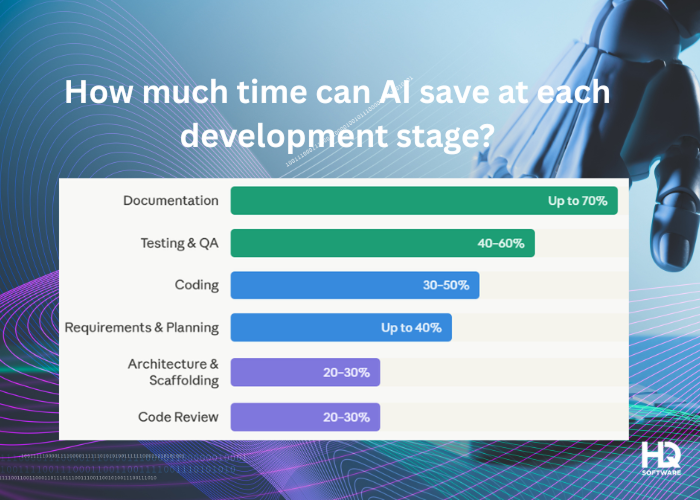
At HQSoftware, we apply AI at every one of these stages as standard practice. Not selectively. Not experimentally. As a result, our clients ship faster without trading quality for speed.
We’re going to be straight with you, because we think honesty is more convincing than hype. It wouldn’t be true to say that AI always speeds up developers’ work.
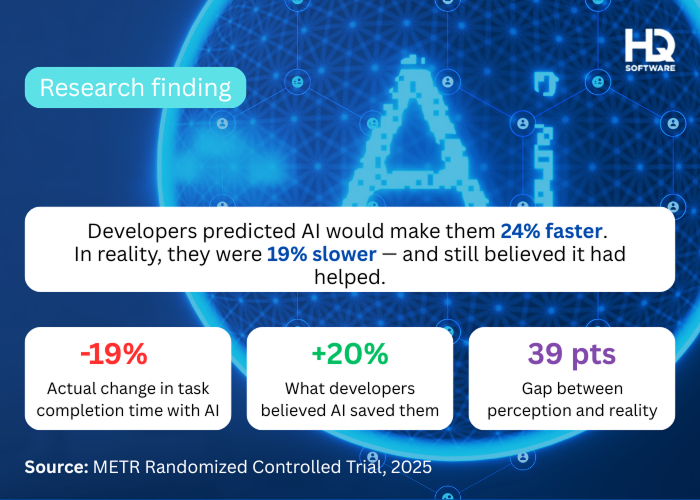
In early 2025, METR ran one of the most rigorous studies of AI developer productivity. They conducted a randomized controlled trial to understand how AI tools affect the productivity of experienced open-source developers working on their own repositories. Surprisingly, they found that when developers use AI coding tools, they take 19% longer than without.
Yes, that’s not a typo. Artificial Intelligence made them slower.
Let’s take a closer look at why this happened and why it matters when choosing a development partner.
They’d worked on the same repositories for an average of five years. When you already know exactly what to do, AI suggestions don’t help; they interrupt. The tool was generating answers to questions the developers weren’t asking.
At HQSoftware, this is something we’ve seen firsthand: on mature client codebases, our senior engineers make a deliberate call on where AI adds value and where it’s faster to work without it. That judgment doesn’t come from a policy document, it comes from their experience.
Over a million lines of code, a decade of accumulated decisions. AI tools struggled to understand the context, sometimes making changes in unexpected places that cost more time to fix than the AI saved.
This is exactly why HQSoftware uses a pilot-first approach on complex existing products — a focused 2– to 4-week engagement on a specific module before scaling up. It allows us to map where Artificial Intelligence accelerates the work and where experienced engineering judgment needs to lead.
Before the study, they predicted a 24% speedup. After experiencing an actual slowdown, they still believed AI had made them faster, estimating a 20% gain. There’s a 39-percentage-point gap between what they felt and what actually happened. That last point should worry anyone relying on gut feeling to evaluate AI ROI.
What does this mean practically? AI delivers when conditions are right. It doesn’t deliver automatically just because you’re using the tools.
The companies seeing 30%–50% gains aren’t just using AI — they’re using it with discipline. Structured review processes. Clear policies for when to use AI and when to override it. Experienced engineers who know the difference between a good AI suggestion and a plausible-looking mistake. That’s the engineering culture HQSoftware has built over the years and it’s what makes the difference between AI that compounds results and AI that creates noise.

Curious what this could look like for your project?
Get a free estimate from HQSoftware and explore how a tailored AI-powered approach can be applied to your specific goals.
Dmitry Tihonovich
Business Development Manager
Greenfield projects are where AI shines brightest. New codebase, clear requirements, bounded scope — this is AI’s natural habitat. Test generation, scaffolding, boilerplate, new feature modules: expect the full 30%–50% gains.
If you’re planning a new product or a significant new feature set, right now is the best time to build it with an AI-native team. The speed advantage is real and measurable from day one.
This requires more nuance and more experience. The METR study shows that AI performs worse in large, complex legacy codebases. That doesn’t mean AI has no role; it means it needs to be deployed surgically. Use it where scope is clear, and rely on engineering judgment where institutional context matters.
This is where having 20+ years of experience and 250+ delivered projects makes a real difference. HQSoftware engineers have worked inside codebases built on decade-old architecture with undocumented decisions and layers of accumulated technical debt. These are the exact conditions where AI without oversight creates more problems than it solves. We know how to read a legacy system, identify where AI accelerates the work, and where a senior engineer needs to lead.
AI code generation may contain subtle security vulnerabilities and lead to solutions that are technically correct but architecturally inefficient. Without proper oversight, this can result in technical debt accumulating faster than with code written by humans. A METR study confirmed this: developers using AI submitted pull requests of similar quality to those who did not use it, but only because the study involved experienced developers who knew what to look for.
Without that oversight layer, quality erodes quietly. You don’t see it until it’s expensive to fix.
At HQSoftware, quality control is built into how we work, not added at the end. Every AI-assisted workflow runs through experienced engineers who review, validate, and where necessary rewrite what the AI produces. This is especially critical for our clients in healthcare and fintech, where a security gap or a compliance failure carries consequences far beyond a delayed sprint.
Not all development tasks benefit equally from AI. Trying to use it everywhere at once is one of the most common mistakes teams make. Here’s how our engineers actually think about it:
AI performs best at the extremes:
AI consistently underperforms in the middle ground (difficulty: 4–8 out of 10): tasks that are complex enough to require judgment but not complex enough to be obviously hard. Mid-level implementation work, tasks with subtle dependencies, anything where “mostly right” isn’t good enough. This is where teams that treat AI as a universal accelerator start accumulating quiet problems.
There is a real skill to working effectively with AI coding tools, and it doesn’t come automatically.
Our developers use different tools for different purposes: Codex for in-project tasks where codebase context matters, ChatGPT for quick standalone scripts and ad hoc problem solving, Gemini for specific use cases where it outperforms the alternatives. Knowing which tool to reach for, and when to put them all down and just write the code yourself, is something that develops over time through actual use.
The teams that get the most out of AI are the ones that treat tool fluency as a genuine skill to develop, not a switch to flip. That means giving developers time to experiment, sharing what works across the team, and being honest about what doesn’t.
As the METR study showed, developers are genuinely bad at assessing whether AI is helping them or not. That kind of blind spot is expensive when you’re making decisions about tooling, team structure, and delivery timelines.
Our recommendations are: track cycle time, deployment frequency, and change failure rate before and after introducing AI tools. These numbers don’t lie. If AI is genuinely accelerating your delivery, you’ll see it in the data within a few sprints. If it isn’t, you’ll know early enough to adjust rather than finding out six months later when the roadmap is still slipping.
At HQSoftware, we’re happy to walk you through how we approach this on client projects. If you’re evaluating whether AI-assisted development could meaningfully change your delivery timeline, let’s talk. A 30-minute conversation is usually enough to give you a realistic picture.

Not sure where to start?
Let’s talk — a 30-minute conversation is usually enough to give you a realistic picture.
Victoria Rokash
Business Development Manager
The AI tooling landscape is moving faster than most teams realize.
Agentic AI workflows are replacing single-tool usage. Instead of one developer working with one AI tool on one task, teams are now orchestrating multiple agents in parallel. For example, one tool helps to write tests, another one is used for reviewing code. The throughput gains from this kind of parallel work are in a different category than anything single-tool productivity studies measured.
Context windows have expanded dramatically. Models can now maintain awareness of entire repositories, not just single files. This directly addresses one of the core conditions under which AI was shown to slow developers down: large, complex codebases where the tool simply didn’t have enough context to be useful.
Speed is now a strategic advantage. The competitive pressure is real and it’s accelerating. Your clients don’t know or care whether a feature was built with AI or without it. They care that your competitor shipped it first.
AI is already transforming software development. The only question is whether your product is being built by a team that knows how to make it work — or a team still running on the old model while calling it “AI-assisted.”
AI in software development is not magic. It’s a powerful tool that delivers real, measurable results when used in the right context by a team that knows how to hold the standard.
When those conditions are in place, the outcomes are real: 30%–50% faster delivery, smaller teams shipping more, better test coverage, fewer surprises after launch.
If you’re planning a software project and want to understand how AI-assisted development could affect your timeline and budget, let’s talk. Our team offers a free consultation where we map out realistic delivery timelines based on your specific requirements.

Head of Production
To ensure the outstanding quality of HQSoftware’s solutions and services, I took the position of Head of Production and manager of the Quality Assurance department. Turn to me with any questions regarding our tech expertise.


Subscribe for more!
We are open to seeing your business needs and determining the best solution. Complete this form, and receive a free personalized proposal from your dedicated manager. Sergei Vardomatski Founder
Kick Off With Your Project Today