The arrival of 2026 is dictating new rules for software development outsourcing. Artificial Intelligence (AI) is rapidly automating software development, testing, and support, while requirements for data security and regulatory compliance continue to tighten. In these conditions, companies face a difficult task: ensuring high-quality IT services, quickly adapting to technological changes, and maintaining control over their budget.
A logical question arises: is it possible to do all of this at once? The answer is yes, if IT outsourcing is viewed not as a cost-cutting tool, but as a strategic resource. Modern outsourcing models go far beyond infrastructure support and are increasingly built around AI-powered software development: they allow you to attract AI-oriented experts, scale teams for specific tasks, and accelerate product launches.
How do you choose a reliable software outsourcing partner in the age of AI? What risks will become critical in 2026, and how can you maintain control over development processes? In this article, we will examine the key challenges, selection criteria, and prospects for software development outsourcing amid the industry’s active transformation.
AI software development outsourcing is a model of cooperation with an external provider or specialized team for designing, developing, implementing, and supporting AI-based solutions. This involves not only creating individual AI modules, but also the entire cycle of work: from data engineering and model training to integrating AI into existing products and business processes.
Why is this model becoming particularly popular in 2026? Instead of building their own AI department from scratch, many companies choose to collaborate with AI outsourcing providers who already have a mature infrastructure, specialized tools, and teams with practical experience in implementing AI solutions in real projects. This approach significantly reduces time-to-market, lowers risks, and allows for flexible scaling of AI initiatives depending on business objectives.
As of 2026, Artificial Intelligence and outsourcing are no longer separate trends — they’re converging into a new industry norm. Recent industry data proves it:
Over half of companies (57%) are forming new outsourcing partnerships specifically with an AI focus, showing a clear shift toward AI-first vendors.
Organizations using AI in outsourcing engagements report that it improves productivity (49%) and increases throughput (45%), enabling faster development cycles and higher output.
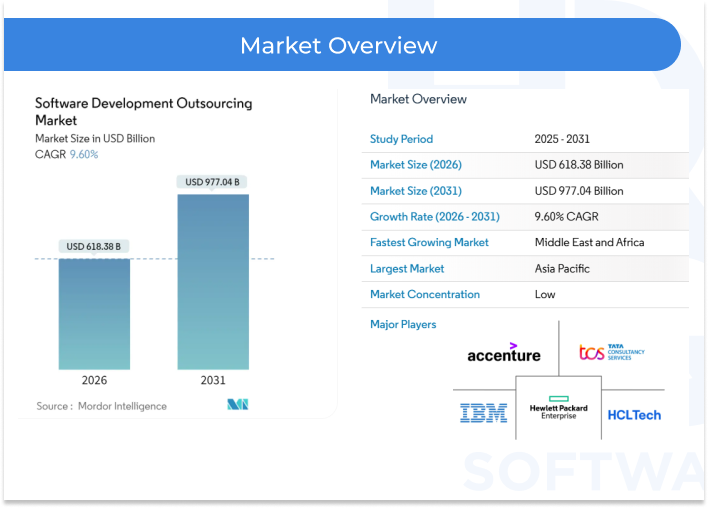
Market forecasts estimate that the global software development outsourcing market will reach ~USD 618 billion in 2026, driven in part by AI adoption and demand for digital transformation.
This data confirms that Artificial Intelligence is not simply expanding the capabilities of traditional outsourcing; it is redefining it. Customers expect software developers to provide AI outsourcing services as a basic requirement, not an added benefit. Therefore, they are increasingly choosing partners based on their AI capabilities and experience.
Do you want to see how companies are already benefiting from AI-powered outsourcing?
Take a look at our case studies to explore real projects, measurable results, and lessons learned.
5 Ways AI Is Transforming Software Development Outsourcing
Software development outsourcing is undergoing significant transformation with the rapid advancement of Artificial Intelligence. AI is reshaping how outsourced teams operate, collaborate, and deliver results. We have identified five key aspects of software development that have been significantly improved and redefined by AI.
1. Faster Delivery and Shorter Development Cycles
Customers often want their project or task to be completed as quickly as possible, but without compromising on quality. In these circumstances, Artificial Intelligence significantly speeds up development processes within the framework of outsourcing. AI-based tools are already capable of generating code, suggesting implementation options, automating testing, and assisting with debugging. This allows outsourcing teams to reduce the time spent on routine tasks and focus on solving business problems.
In 2026, this will translate into shorter development cycles, faster MVP launches, and the ability to release updates more frequently. For companies working with external contractors, AI-powered software development means reduced time-to-market without compromising product quality.
2. Changing Team Structure and Roles
AI is fundamentally reshaping team structures within outsourced software development. There is a growing demand for specialists with expertise in designing, implementing, integrating, and deploying AI-driven solutions. Besides development itself, companies increasingly rely on outsource professionals to be responsible for auditing AI systems, validating training data, monitoring model outputs, and ensuring that AI-driven decisions align with their business and ethical standards.
Despite rapid progress, AI-powered software development remains imperfect. Issues such as model hallucinations, biased data, and flawed algorithms continue to pose real risks in production environments. As a result, human oversight becomes not less critical, but even more so. Engineers, AI auditors, and domain experts play a key role in identifying errors, correcting model behavior, and making final decisions in high-impact scenarios.
AI readiness audit helps uncover gaps in datasets, detect bias, and ensure your training data is suitable for building reliable AI systems.
In 2026, successful outsourcing teams are no longer built solely around developers and testers. Instead, they combine AI-assisted workflows with human expertise, creating hybrid teams where people focus on strategy, governance, quality control, and complex problem-solving. These are areas where AI still requires strong human supervision.
3. AI-Powered Quality Assurance and Code Review
Quality control is one area where the AI impact on software outsourcing is particularly noticeable. AI tools can automatically generate test cases, identify anomalies, and analyze code quality on a scale that is not possible with manual testing.
Industry data shows that AI-based systems enhance test coverage analysis and defect detection, leading to 31%–45% improvements in overall software quality and a 15%–20% reduction in non-productive defects within QA practices. These improvements mean that outsourcing teams can identify issues earlier and deliver more stable, production-ready software.
However, it should be noted that human expertise is still needed when it comes to evaluating architectural decisions and validating business logic. In this context, AI acts more as a tool for improving accuracy and quality stability.
4. More Accurate Project Estimation and Risk Management
Artificial Intelligence is changing the approach to assessing deadlines and risks in outsourcing projects. By analyzing historical data, team performance indicators, and technical complexity, AI systems enable more accurate forecasts of deadlines, budgets, and resource utilization.
In 2026, many outsourcing providers are using AI to identify potential risks early on, from skill shortages to threats of missed deadlines or increased workloads. For customers, this means greater predictability, transparency, and control throughout the project lifecycle.
5. Enhanced Security and Compliance
As data protection and regulatory compliance requirements become more strict, AI is becoming a key element of security in outsourced software development. AI systems are capable of monitoring vulnerabilities, abnormal behavior, access policy violations, and potential incidents in real time.
This is especially important for outsourcing: distributed teams, multiple contractors, and cross-border data transfers significantly increase the complexity of security management. In 2026, AI-supported security and compliance will reduce operational risks, minimize human error, and meet regulatory requirements without slowing down development processes.
Want faster, smarter software development for your business?
Our team is ready to walk you through what AI-powered outsourcing can do for your specific goals.
Despite its obvious advantages, AI software development outsourcing is accompanied by a number of hidden risks and limitations. Automation and AI tools accelerate processes, but at the same time create new areas of responsibility, uncertainty, and management challenges. Let’s take a look at the key issues facing companies in 2026.
AI Code Quality Concerns
Although Artificial Intelligence can generate code faster than humans, the quality of such code does not always meet the requirements of the production environment. AI models may propose non-optimal architectural solutions, use outdated practices, or generate code without sufficient consideration of the business logic context.
In addition, there is still a risk of “hallucinations” — situations where the model creates code that looks correct but is actually incorrect or unsafe. This is a particularly critical problem in outsourcing, as the customer does not always directly control the development process. Without strict code review and architectural control, using AI can lead to the accumulation of technical debt.
The Trust Gap
One of the most difficult problems remains the lack of trust in both AI systems themselves and contractors who actively use Artificial Intelligence in outsource software development. Customers often ask themselves: Who is responsible for mistakes made by AI? Can the results generated by the model be completely trusted? How transparent is the development process?
If a contractor does not demonstrate transparency in AI-powered software development and quality control mechanisms, a “trust gap” arises between the customer and the service provider. In 2026, when choosing a partner, trust is no less important a factor than price or project speed.
IP Protection and Data Security
Using AI tools in outsourced software development increases risks associated with protecting intellectual property and confidential data. Many AI models are trained on external data or use cloud infrastructure, which can create additional legal and regulatory risks. This raises questions:
Who owns code that is partially generated by AI?
Are fragments from public repositories used?
How is sensitive customer data handled when training or using models?
For companies operating in regulated industries (finance, healthcare, government), these risks can be critical. To reduce risk and avoid negative consequences, companies must implement strong security measures.
Security Risk
Impact
Mitigation Strategy
Human error
Accidental data leaks, weak passwords, phishing-related breaches
Provide regular security training, limit access based on roles, and use multi-factor authentication (MFA) for all critical systems
Sensitive data exposure via AI tools
Confidential client data may be processed or stored insecurely
Use only approved enterprise AI tools, avoid uploading sensitive data to public models, and anonymize data whenever possible
Unauthorized access to source code
Theft of intellectual property or manipulation of the product
Restrict repository access to authorized team members, enable activity logging, and use encrypted storage
Third-party tool risks
Loss of control over how data is handled by external AI providers
Carefully review third-party vendors, include data protection clauses in contracts, and choose private or on-premises deployments when needed
Delayed threat detection
Breaches remain unnoticed for long periods, increasing damage
Implement continuous monitoring, automated alerts, and a clear incident response plan
Regulatory non-compliance
Legal penalties and reputational damage
Conduct regular compliance audits and ensure development processes align with GDPR, HIPAA, or other relevant standards
The “AI Flooding” Bottleneck
It may sound paradoxical, but excessive use of AI can slow down processes. When Artificial Intelligence generates large amounts of code, documentation, or tests, the so-called “AI flooding” effect occurs. This is a kind of overload of the team with automatically generated results.
Developers are forced to spend a significant amount of time checking, filtering, and correcting the generated material. This may partially offset the expected time savings. In addition, excessive AI code without a clear architectural strategy increases the risk of technical debt and complicates product support in the long term.
As part of the HQSoftware team, we’ve seen in practice that the challenges listed above can indeed become a serious barrier to implementing AI software development outsourcing. However, these risks are not critical — much depends on mature processes, transparent interaction, and the team’s level of expertise.
An experienced outsourcing company is capable of building an effective quality control system, implementing clear policies for the use of AI tools, ensuring code auditing, and providing transparency at all stages of development. It is important not just to use AI, but to integrate it into processes in a conscious and controlled manner.
How to Choose an AI-Forward Software Outsourcing Partner
Your choice of an outsourcing company to develop an AI-based solution is a key factor, one that will strongly influence whether the entire project succeeds. Let’s consider several criteria that will help you make the right choice.
Experience and reputation. First and foremost, check the company’s experience in AI outsourcing services. Portfolios, customer reviews, and successfully completed projects can serve as indicators of reliability and professionalism.
Technical skills. Make sure your potential partner company has the necessary competencies to work with your specific tasks. This may include expertise in certain areas, such as Machine Learning (ML), Natural Language Processing (NLP), or computer vision.
Compatibility. It is important that your company’s business processes and corporate culture align with the approaches and principles of your outsourcing partner. This will enable effective collaboration and smooth integration of AI solutions into your company.
Terms of cooperation. Before signing a contract, carefully review the terms of cooperation. Discuss all aspects: cost of services, deadlines, level of support, etc. It is also worth paying attention to the possibility of obtaining results at each stage of development.
Support and maintenance. Make sure the company provides support after the project is completed. Ongoing maintenance of the AI solution may be necessary in case of updates or scaling.
Questions to Ask Your Outsourcing Vendor About AI
At HQSoftware, we recommend going beyond a general portfolio review and asking direct, structured questions about how AI is actually used in the outsourced software development process. The answers will help you assess not only technical expertise but also process maturity and risk awareness.
How exactly do you use AI in your development workflow? Is AI applied to code generation, testing, documentation, DevOps, or project estimation?
What AI tools and models do you use, and why? Are they using public LLMs, proprietary models, or on-premises solutions? How do they evaluate tool reliability and limitations?
What quality control mechanisms are in place for AI-generated code? Is there mandatory human code review? Are there internal guidelines regulating AI usage?
How do you prevent AI hallucinations and biased outputs from affecting production systems? Ask about validation processes, testing pipelines, and human oversight practices.
How do you ensure IP protection and data security when using AI tools? Is client data used to train models? Where is the data processed? What compliance standards are followed?
Who is responsible if AI-generated output causes defects or security issues? Clarify responsibility and risk allocation in contracts.
How do you measure the effectiveness of AI in your projects? Do they track productivity metrics, defect reduction, delivery speed, or cost efficiency?
Can you provide real case studies of AI-powered projects? Request concrete examples, measurable results, and lessons learned.
Ready to find out if we're the right fit for your project?
Let’s talk through your goals, challenges, and requirements — no commitment needed.
Why HQSoftware Is a Reliable AI Outsourcing Partner
At HQSoftware, we approach AI software development outsourcing not as a trend, but as a structured, engineering-driven discipline. Our focus is not only on implementing AI technologies, but on integrating them responsibly into scalable, secure, and business-oriented solutions.
We provide comprehensive AI outsourcing services, covering the full development lifecycle — from consulting and analysis to deployment and long-term support.
AI consulting and strategy – We help companies discover the most valuable AI use cases, assess their feasibility, and create clear roadmaps to implement solutions that deliver real business impact.
Custom AI software development – We design and build AI systems tailored to your needs, including ML models, NLP, Computer Vision, predictive analytics, and intelligent automation tools.
AI integration – We seamlessly embed AI capabilities into your existing products and workflows, ensuring smooth adoption without disrupting your business processes.
AI-enhanced development processes – We use AI tools responsibly to accelerate coding, automate testing, and improve project management, while maintaining strict human oversight and quality control.
ML operations and infrastructure setup – We set up robust deployment pipelines, monitoring, and scalable infrastructure to ensure that AI systems are reliable, secure, and easy to maintain over time.
At HQSoftware, our team is not only highly skilled and responsible, but also genuinely collaborative and flexible. We adjust to your time zones, priorities, and unique business needs, ensuring smooth communication at every stage. Even when working remotely, we foster a sense of true presence and partnership, making it feel as if our experts are sitting right alongside your team, fully invested in the success of your AI initiatives.
How AI Is Changing Outsourcing Pricing and Engagement Models
From Hourly Rates to Value-Based Pricing
Traditional outsourcing models are most often based on hourly rates or fixed prices per project. This means that the client pays for the amount of time or number of people involved in the work. However, in the age of Artificial Intelligence, this perception is increasingly becoming obsolete. The automation of AI-generated tasks breaks the direct link between the time spent by people and the actual value the client receives.
As a result, modern companies are increasingly considering value-based pricing, where payment is linked not to hours worked but to the results the solution brings. This approach helps customers plan their budgets better and focus on specific business goals, such as reducing costs, increasing revenue, or improving efficiency.
Another trend is usage-based or performance-based pricing, where the cost of the service depends on actual resources consumed or the achievement of certain indicators. Such models are already used in AI-oriented products (for example, payment for processed tokens, the number of successfully completed operations, or achieved KPIs).
What Happens to Outsourcing Costs With AI?
AI’s impact on software outsourcing costs is ambiguous. On one hand, automation and AI reduce routine tasks, which leads to lower base rates for certain services. For example, research data shows a reduction in prices for individual service functions or automated services of up to 30%–50% compared to fully manual processes, especially where AI takes over part of the work.
On the other hand, AI integration can bring new costs related to computing power, infrastructure, licenses, and model operation (e.g., cloud computing or API usage fees). Thus, in the long term, the cost of a project consists not only of people and hours, but also of the cost of these technologies, support, and adaptation to customer needs.
Currently, pricing is becoming more flexible and diverse. For example, mixed models, where part of the work is carried out by a human and part by an AI agent, as well as models linked to efficiency and results, are already appearing in large projects.
Wrapping Up
AI software development outsourcing offers many opportunities for businesses. It not only saves time and money, but also provides access to necessary knowledge and technologies. However, for successful cooperation, it’s important to choose the right partner and understand which technologies are currently relevant.
If you’re exploring AI software development outsourcing or planning your next AI initiative, we’d be happy to share our experience and insights. At HQSoftware, we believe every successful AI project starts with a clear strategy and the right technical foundation. Let’s discuss your goals, challenges, and opportunities — and define a practical roadmap tailored to your business needs.
An experienced software developer specializing in IoT and AI-driven technologies. Having contributed to more than 20 IoT projects, shares practical expertise and insights on connected software development, AI integration, and intelligent solutions.
AI is unlikely to replace outsourcing entirely. Instead, AI software development outsourcing is evolving into a more technology-augmented collaboration model. While AI automates routine tasks, businesses still need experienced engineers for architecture, security, integration, and strategic decisions. Human expertise remains essential for delivering reliable, scalable software solutions.
What Is Vibe Coding and How Does It Affect Outsourcing?
Vibe coding refers to AI-assisted development where engineers use generative tools to quickly prototype or generate code based on intent rather than detailed specifications. This approach accelerates early stages of projects but still requires strong review, validation, and architecture oversight from experienced outsourcing teams.
Does AI Reduce the Cost of Software Outsourcing?
AI can reduce certain operational costs by automating repetitive coding, testing, and documentation tasks. However, overall, the AI impact on software outsourcing depends on infrastructure, licensing, and governance requirements. In many cases, AI optimizes efficiency and speeds delivery rather than simply lowering total project costs.
How Does AI Change the Team Size Needed for an Outsourcing Project?
AI tools can reduce the need for large teams handling repetitive work, allowing companies to outsource software development with leaner, more specialized teams. Instead of increasing headcount, the focus shifts to highly skilled engineers who supervise AI tools, validate outputs, and ensure architectural consistency.
What Are the Risks of Using AI in Software Development Outsourcing?
Key risks include code quality issues, data security concerns, overreliance on automation, and lack of transparency in AI-generated outputs. As part of broader software development outsourcing trends, companies increasingly address these risks through governance frameworks, strict review processes, and responsible AI integration practices.
We are open to seeing your business needs and determining the best solution. Complete this form, and receive a free personalized proposal from your dedicated manager.
Sergei Vardomatski
Founder
We use cookies to analyze traffic, personalize site content, and for social media features. We share this
data with our ad and social media partners. You can change your cookie settings and learn more
here. By browsing the website you consent to our rules.