A distributor launches an Artificial Intelligence (AI) forecasting pilot. The team feeds it years of orders from the enterprise resource planning system (ERP). Months later, the forecast still misses the items that matter most. Nobody trusts it, and the pilot quietly dies.
The promise is real. AI demand forecasting can cut errors by 20 to 50 percent, McKinsey reports. Yet Gartner predicted that companies lacking AI-ready data would abandon 60 percent of AI projects.
The cause is rarely too little data. Your ERP holds years of it. The real problem is shape: it records what you shipped, not what customers wanted. This guide shows what data you need first, so AI in distribution pays off instead of stalling.
Do Distributors Have Enough Data for AI Forecasting?
Usually yes, but not always the right kind. Most distributors hold years of records. The real question is whether those records show what customers wanted to buy.
The Good News: Volume Is Rarely the Problem
Many teams delay forecasting because they think their data is too thin.McKinsey’s research on forecasting in data-light environments says otherwise. It finds that most organizations already have enough data to get value from AI-driven forecasting, even when data quality varies widely.
The same research reports that AI can reduce lost sales and product unavailability by up to 65 percent. Keep the scope in mind. That figure, like the error reduction mentioned earlier, covers supply chains broadly, not distributors specifically. The article also dates from 2022. Treat it as a sign of what is possible, not a promise.
More history still helps, McKinsey notes. But a short record is no reason to postpone Machine Learning (ML) demand forecasting.
The Bad News: Your Data May Not Be AI-Ready
Having data and having usable data are different things.Gartner’s survey shows how wide the gap is. Sixty-three percent of organizations either lack the right data management practices for AI or are not sure they have them.
Gartner’s advice is to match your data sources to the specific AI use case. Records become AI-ready data only when they fit the question you ask the model. Size alone does not get them there.
Your ERP is a good example. It holds years of orders, but it was built to ship goods and send invoices. It was not built to record demand. When an item is out of stock, the system logs no sale. The customer who wanted it leaves no trace. A model trained on that history learns the wrong lesson: that demand was low. This is why demand forecasting data requirements start with fit, not size.
Want to turn scattered data into AI that delivers real results?
See how HQSoftware turns complex data into reliable, production-ready AI solutions. Explore our case studies to discover real projects, practical applications, and measurable business impact.
Four types of data matter before any model runs. Each section below ends with a question for your team.
Order History That Shows True Demand
Think of your ERP order history as a diary. It makes note of what customers ate, but not what they were hungry for. Stockouts erase that ‘hunger’ from the record. Your historical sales data mixes information about orders, shipments, and invoices. Orders show what customers asked for. Shipments show what you delivered. A model needs to know what they were asking for, but exports often only show what was delivered.
Say a customer orders 100 units and you only have 60. You ship 60, and the customer cancels the rest. The history shows a sale of 60. Backorders and cancellations vanish the same way. Lost sales leave even less trace. A buyer sees an empty shelf and calls a competitor, so no order exists. A model trained on shipments reads your stockouts as low demand. Then it suggests buying less of what you already lack.
Test question: for our top 20 items, can we show how many units customers wanted last quarter but did not get?
Clean Item and Customer Master Data
Messy records split a good history into fragments. Long catalogs make this a classic distributor problem. A part gets replaced, and your team creates a new stock keeping unit, or SKU. The old code’s history stops, and the new one starts empty. The same bolt may also sit under two codes, or sell by piece, box, and pallet. Customers merge or split, too.
Check whether your ERP links old and new SKUs and stores one base unit per item. This is basic master data management.
Test question: if we pick five long-running products, can we trace their full history across every code and unit?
Inventory Positions and Supplier Lead Times
A forecast helps only when it becomes a reorder decision. For that, you need to consider stock levels, supplier lead times, and supplier reliability. And add safety stock, the buffer that covers late deliveries and forecast misses.
Daily stock records also show which days an item was empty. Those are the days your sales history understates the actual demand. This is what separates inventory forecasting from plain sales prediction: the output advises how many units to order and when.
Many ERPs base decisions on a standard lead time that nobody has updated in years. Good AI inventory forecasting needs the real one.
Test question: for our top ten suppliers, do we know the real average lead time and how much it varies?
Calendar and Promotion Context
A model cannot see why sales jumped unless you tell it. Holidays, price changes, promotions, and contract changes all move demand. Without flags, your model will treat a one-off spike as a trend.
Picture a supplier price rise in April. Customers stock up in March, then buy little in April. The model reads March as growth and overorders.
Most distributors keep these events in emails and planner spreadsheets, not next to order lines.
Test question: can we list every promotion, price change, and contract change from the last two years, with dates and affected items?
Does External Data Improve AI Demand Forecasting?
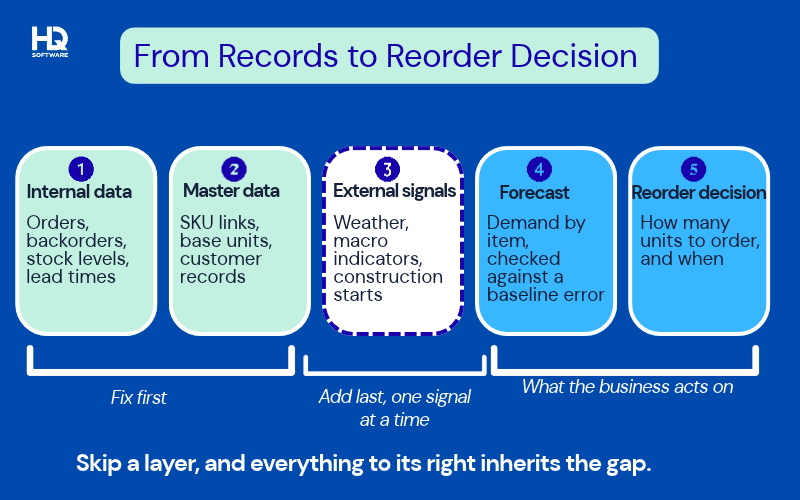
Yes, but only after your internal data is in order. Outside signals can sharpen a forecast. They cannot repair a broken order history.
When External Data Earns Its Place
External signals include weather, macroeconomic indicators, and construction starts. For a building-products distributor, these factors can explain swings that your own history cannot. Using fresh outside data to adjust near-term forecasts is called “demand sensing.”
McKinsey also names external data as one way to make up for thin history. There’s a catch, though. Every new source brings new cleaning, matching, and upkeep work.
So keep the order simple. First, fix your orders, master data, stock records, and event flags. Then test one external signal at a time. Keep that signal only if it improves the forecast on your own items. External data is seasoning: it lifts a good dish and cannot save a burnt one.
The Long-Tail Problem: Intermittent Demand
Many distributors carry thousands of slow-moving SKUs. Their sales look like a row of zeros with a random spike. This is intermittent demand, and intermittent demand forecasting is a harder task than forecasting fast movers.
Standard accuracy metrics struggle here, and some break when actual sales are zero. Many models also learn little from a series that is mostly empty.
Be honest about the limits. AI does not fix every SKU equally. A fast mover with a steady history may gain a lot. A part that sells twice a year may not.
So segment the catalog first. Split items by how often and how steadily they sell. Then match the method to each group, and set modest goals for the slow tail.
Not sure your records show true demand?
A readiness audit tests your order history, master data, and lead times against what a forecasting pilot needs.
Why Do AI Forecasting Pilots Stall? Four Data Traps
Many pilots never reach production, and the cause is often the data, not the model. The team builds a promising demo, then stays stuck in pilot purgatory. Watch for these four traps.
Forecasting Shipments Instead of Demand
You met this trap in the true demand section above. A model trained on shipments repeats your past stockouts in the future. Check that your pilot data includes orders, backorders, and lost sales.
Data Locked in Legacy ERP and Spreadsheets
Many distributors run an old ERP, a warehouse management system, or WMS, and a stack of Excel files. Each holds part of the picture. Planners export, fix, and send data by hand. That is technical debt in plain view: every old shortcut now costs time.
Branches add another layer. One site codes items one way, another site uses different codes. A pilot must pull it all together, so plan ERP integration early.
No Agreed Accuracy Baseline
Money is flowing faster than proof.Gartner’s August 2026 survey found that 55 percent of chief supply chain officers are unclear on the return from their AI investments. Yet 67 percent of supply chain digital investment now goes to AI.
Measure your current forecast accuracy before the pilot starts. A common metric is mean absolute percentage error, or MAPE. It shows the average gap between forecast and actual sales as a percentage. Record MAPE for today’s method, even if that method is a spreadsheet. Without it, nobody can prove the pilot worked. MAPE fits fast movers best, because it breaks when actual sales are zero.
No Owner for the Data
Who fixes a wrong lead time? Who approves a SKU merge? If nobody knows, data quality slips after the pilot ends, and the forecast slips with it. Data governance answers this in plain words: each data field has an owner, and each change has an approver.
How Can You Check Your Data Before You Start?
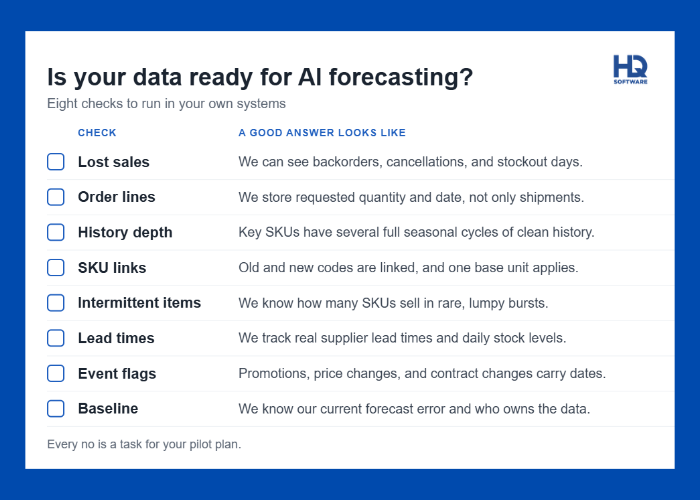
Run a short audit of your own systems. Eight checks tell you most of what you need to know.
A Practical Data Readiness Checklist
Use this list to see whether you have AI-ready data for a forecasting pilot. Every “no” is a task for your pilot plan.
Check
A good answer looks like
Lost sales
We can see backorders, cancellations, and stockout days.
Order lines
We store requested quantity and date, not only shipments.
History depth
Key SKUs have several full seasonal cycles of clean history.
SKU links
Old and new codes are linked, and one base unit applies.
Intermittent items
We know how many SKUs sell in rare, lumpy bursts.
Lead times
We track real supplier lead times and daily stock levels.
Event flags
Promotions, price changes, and contract changes carry dates.
Baseline
We know our current forecast error and who owns the data.
Real-World Example: Clean Data First, Accuracy Second
This story comes from finance, not forecasting. We use it as a parallel, because the lesson carries over.
A mid-sized insurance company had 12 branches in Germany. Its reports came from branch spreadsheets and exports from SAP, Salesforce, and Excel. Each cycle took five days and produced many errors.
HQSoftware’s solution put the data layer first. It pulled every source into one platform. An AI module then flagged inconsistencies and duplicate records before any report appeared. The result was up to 85 percent fewer errors, and reports arrived in one day instead of five.
Distributors face the same pattern: scattered sources, duplicates, and manual exports. Fix the pipeline first. Accuracy follows.
Build, Buy, or Audit First?
Three paths exist for demand planning AI. Established off-the-shelf demand planning platforms offer ready workflows and a fast start. Cloud ML forecasting services, which run on infrastructure such as Microsoft Azure or AWS, give you flexible models to configure. Custom forecasting models fit unusual catalogs, but they need engineering and MLOps, the practice of deploying and monitoring models.
Each path has a place. None of them cleans your data. A platform will still learn from shipments. A cloud service will still stumble on split SKUs. A custom model will still inherit your blind spots.
So answer the data question first. A data & AI readiness audit tests your order history, master data, and lead times against what a pilot needs. The result shows which path fits. If you choose to build, ourMachine Learning team can take it from there.
What Results Can You Expect, and When?
Expect real gains, but plan in months, not weeks.McKinsey’s research on AI in distribution operations says AI can cut inventory by 20 to 30 percent, logistics costs by 5 to 20 percent, and procurement spend by 5 to 15 percent. Treat these as upper-range figures, not a promise. They describe what AI can create across operations, and your results depend on your data.
McKinsey’s advice is practical. Pick one or two low-risk, high-value use cases. Deliver them within three to four months. That shortens time-to-value, or TTV, and earns trust for the next step.
Start narrow, with fast-moving SKUs and clean history. Measure the pilot against your baseline, because better forecast accuracy is the first proof. Bring the forecast into your sales and operations planning, or S&OP, meeting. Plan change management too. Predictive analytics pays back only when planners trust the numbers and act on them.
Early wins also move your digital transformation forward. Each data source you fix helps the next project, not just this one.
Not sure your order history is ready? We can review it with you and show what a forecasting pilot would need. Book a data & AI readiness audit.
An experienced software developer specializing in IoT and AI-driven technologies. Having contributed to more than 20 IoT projects, shares practical expertise and insights on connected software development, AI integration, and intelligent solutions.
How Much Historical Data Do You Need for AI Demand Forecasting?
AI demand forecasting needs historical sales data that covers several full seasonal cycles, not a fixed number of years. The model must see each season repeat to tell a pattern from a one-off spike. New items with short history can often be grouped with similar products. McKinsey notes most organizations already hold enough data to start.
Does AI Demand Forecasting Really Work for Mid-Size Distributors?
AI demand forecasting works for mid-size distributors when their data records true demand, because record quality matters more than company size. Published results usually cover supply chains broadly, not mid-size distributors specifically. So start with one product group and measure the pilot against your current method before you scale demand planning AI.
When Does AI Demand Forecasting Not Make Sense?
AI demand forecasting does not make sense when your data cannot show true demand or your catalog is small and stable. If a planner already forecasts a few hundred steady items well, a simple method may beat AI. Build AI-ready data first, then test whether AI adds value.
Can AI Forecast Demand for Slow-Moving or Intermittent Items?
AI can forecast slow-moving and intermittent items, but the gains are smaller than for fast sellers. Items with mostly zero sales give models little to learn from. Segment the catalog, use methods built for intermittent demand forecasting on the slow tail, and expect lower forecast accuracy there.
Why Do AI Forecasting Pilots Fail to Reach Production?
When AI forecasting pilots fail to reach production, it’s usually because of data and ownership problems, not the model. Common causes are training on shipments instead of demand, data stuck in legacy systems, no accuracy baseline, and no data owner. Meeting these demand forecasting data requirements before the pilot starts removes the most common blockers.
What Is the Difference Between AI and Traditional Statistical Forecasting?
Traditional statistical forecasting projects each item’s past sales forward, while ML demand forecasting also learns from other inputs and from patterns across items. Those inputs include price changes, promotions, and weather. That helps with messy, changing demand. But AI needs cleaner data and more upkeep, and simple methods still win on stable items.
How Long Does It Take to See Results From AI Demand Forecasting?
A well-scoped first pilot can show results in three to four months, according to McKinsey’s guidance on AI in distribution operations. That means picking one or two low-risk, high-value use cases. Data cleanup can add time, so check your records first. Measure forecast accuracy against your current method to prove the gain.
Do You Need to Replace Your ERP Before You Start AI Forecasting?
You do not need to replace your ERP before starting AI forecasting, because models can read data from your current systems through integration. The real task is making sure the ERP keeps the right records for AI inventory forecasting, such as order lines, backorders, and lead times. Replace it only if it cannot store or export them.
We are open to seeing your business needs and determining the best solution. Complete this form, and receive a free personalized proposal from your dedicated manager.
Sergei Vardomatski
Founder
We use cookies to analyze traffic, personalize site content, and for social media features. We share this
data with our ad and social media partners. You can change your cookie settings and learn more
here. By browsing the website you consent to our rules.